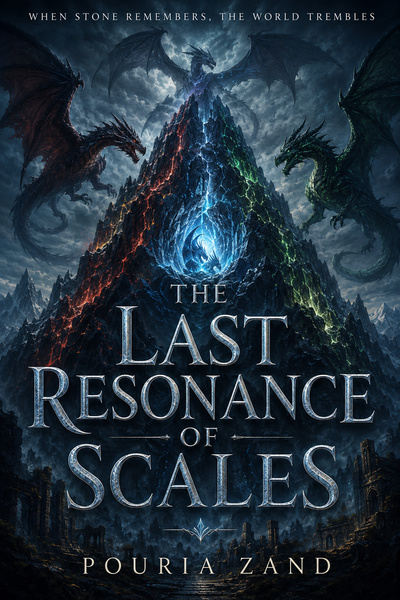
CHAPTER THREE: "THE SILVER SURGE"
---
🔗 BRIDGE FROM CHAPTER TWO
While the Egg pulsed in Kreitor-Zar Valley, its heartbeat echoed through the mountain's spinal column. In Mont Vala, an old woman woke from sleep—because the stone beneath her pillow had grown warm for the first time in seventy years.
She told her son: "Something in the mountain is waking."
Her son laughed.
But that same night, the first vein of colorless Astria surged from a fissure in the earth—and the mountain remembered how to weep.
---
CHAPTER THREE: THE SILVER SURGE
---
PART ONE: THE VILLAGE THAT REMEMBERED HOW TO BLEED
Mont Vala clung to the northern shoulder of Mount Silverpeak like a scar that had healed but never forgotten its wound. The houses were built from the mountain's own stone—not for beauty, but for survival. Each wall was three meters thick. Every window faced south, because the north offered only wind, and wind was nothing but a reminder of death.
But the people of Mont Vala were accustomed to death.
What they were not accustomed to was the silence of the stones.
For generations, the village had produced only one thing: the silver-hued metal called Astria. A metal that welled up from the earth's core—not mined, not veined, not quarried. It surged. On certain nights of the year, the ground would split and molten metal, the color of a zealot's fever dream, would erupt from the depths. They called it the "Mountain's Tears."
With clay molds, the people caught those tears. Cooled them. Shaped them. And sold them to merchants who sailed from the south on ships whose very hulls were forged from the same metal—though no one knew it.
The finest grade of Astria—what they called "Living Silver"—was birthed only on the Great Surge Night, in the northern reaches of the isle, beneath the fortress of Mont Vala. This metal hung from cavern ceilings like luminous stalactites. Each stalactite was worth a fleet. Each fleet, a kingdom.
But this year's Surge Night was different.
The stalactites that emerged were colorless—not silver, not blue, not white. Like tears that had forgotten why they were shed.
The elders whispered that the earth was grieving. The children dreamed of dragons. And one woman—old Mira, who had lived through seventy Surge Nights—placed her hand on a stalactite and whispered:
"You're not crying for us. You're crying for something beneath us."
No one listened.
They never did.
---
PART TWO: THE REEVE AND HIS GUESTS
That night, the Reeve of Mont Vala sat in his fortress.
His name was Lord Holderic. Fifty years old, but his hair was pure white—not from age, but from choice. Each white strand marked a sleepless night in which he had been forced to choose between one man's death and everyone else's survival.
He had not chosen well. Not always.
But he had chosen.
His guests had come from the north.
Reeve Gardon, Warden of the Northern Territories. A man with a beard so thick it lay upon his chest like a fallen forest. Eyes the color of raw Astria. In his left hand, he always held a goblet; in his right, a quill. They said he wrote death warrants with the quill and toasted death itself with the goblet.
He had brought with him:
· Three sons—the eldest of whom we shall meet in due time.
· His wife, Lady Elsa—a woman who, when she spoke, hushed the entire hall, not out of respect, but for fear of losing a word that might never be heard again.
· Six guards, whose shadows fell upon the fortress walls like warnings.
Lord Holderic received them in the great hall. A table laid with mountain goat, barley bread, and wine aged in Astria vessels. But no one ate. Everyone waited.
Waited for the Surge.
Yet something was wrong.
Lord Holderic noticed it first: his brother-in-law, Darius—manager of the Astria stores—was not at the table. Darius was supposed to be in the northern caverns, watching over the stalactites.
Gardon noticed second: his wife Elsa had not touched her wine. She was staring at the wall—not at the tapestries, but at the stone itself.
And Kain, Gardon's eldest son, noticed third: the stones beneath his feet were warmer than they should be.
He said nothing. He never did.
But he watched.
---
PART THREE: THE ASSESSOR
Kain was twenty years old, and in that entire hall, no one looked lower than him—except perhaps the stones beneath their feet.
His eyes were like two shards of dark blue ice that neither melted nor reflected—they only watched others melt. Black hair fell across his brow, so that when he lowered his head, no one could guess what he was thinking.
But that wasn't his defining trait.
Kain never smiled. Not from coldness—but because he considered smiles incomplete. He believed a smile was the pinnacle of weakness, because it meant something had made you happy—and anything that could make you happy could also destroy you.
He was neither lover nor hater. He was an assessor.
And that night, he assessed something no one else had noticed.
During supper, his uncle Darius glanced at the wall clock three times. Once too many. Darius managed the Astria stores. He wasn't supposed to be in the fortress. He was supposed to be in the northern caverns.
But more than that—Darius's hands were trembling. Not from fear. From excitement.
Kain had seen that tremor before. On the face of a merchant who had just made a deal that would change his life.
Kain said nothing.
He slipped out of the hall, unseen. Descended the spiral stairs of the fortress. Exited through the hidden door behind the kitchen—known only to the Reeve and his kin. But Kain knew everything. Because he always listened. And no one ever considered listening dangerous—until it was far too late.
---
PART FOUR: THE BETRAYAL
In the northern caverns, beneath the filtered moonlight of Astria, Kain saw his uncle.
Darius was lashing the greatest haul of pure stalactites—the ones meant for the Great Surge—to a boat that waited on the isle's hidden shore.
A southern merchant. A cargo worth three kingdoms. A betrayal.
But there was something else. Something Kain had not expected.
Darius was not loading the stalactites with greed. He was handling them with reverence. As if they were holy relics. As if he were not stealing them, but rescuing them.
And he was talking to the stones.
"I know," Darius whispered, his voice echoing in the cavern. "I know you're not just metal. You're memory. And I'm taking you to someone who can hear you—someone who can remember with you."
If you discover this tale on Amazon, be aware that it has been unlawfully taken from Royal Road. Please report it.
Kain froze.
His uncle was not a traitor. He was a believer.
And that made him more dangerous than any thief.
Kain drew his bow—not of wood, but of bone from a small dragon he had found in the mountains years ago. He didn't aim. He had forgotten how to aim. He simply knew where the arrow would go. He always knew.
But for the first time, he hesitated.
Because Darius turned around and looked directly at him—through the darkness, through the distance, through the years of silence between them.
"Kain," Darius said softly. "I knew you would come. You always watch. But tonight... I need you to understand."
Kain's hand tightened on the bowstring.
"Understand what?"
Darius gestured to the stalactites. "These stones... they're not crying for us, Kain. They're crying for something beneath us. Something the dragons buried long ago. And if we don't find it—if we don't listen—it will stay buried forever. And we will never know why we were born."
Kain stared at his uncle. For a moment, he saw not a traitor, but a man who had found something worth dying for.
Then he remembered his father's words: "Duty is not about understanding. It's about doing."
He loosed the arrow.
It struck Darius in the back—not one, but two. The second was for certainty, not cruelty. Out of respect for finality. When Kain started something, he finished it. Even if the ending was the death of his own blood.
Darius fell without a sound. But as he fell, his hand reached out—not in defense, but in offering. He pressed a single piece of Astria into Kain's hand. A piece that glowed red. The color of blood on iron.
And with his last breath, Darius whispered:
"Take it... to the southern merchant... he'll know... what to do..."
Then his eyes went still.
Kain knelt beside his uncle. For a long moment, he did not move. He looked at the face of the man who had taught him how to read the stones. The man who had shown him the secret passages. The man who had believed in something greater than gold.
He closed Darius's eyes with his own fingers.
"This time when I rise, Uncle... you're not my uncle anymore. Just a memory."
Then he set the boat ablaze with a flaming arrow. Hid the body in a crevice of the cavern—where stone devours secrets. And returned to the fortress, as though he had only stepped out to relieve himself.
But in his pocket, the red Astria pulsed against his thigh. Warm. Alive. Remembering.
---
PART FIVE: THE MORNING OF DECISION
At dawn, the pale northern sun crept from behind the clouds, drowning Mont Vala in a gray light. But the people did not look to the sun. They looked to the northern shore, where the remains of the burnt boat lay like the bones of a sea giant upon the sand.
The cry of discovery woke the village.
Lord Holderic, with eyes that had not slept—because the Surge Night had passed and no stalactites had come—ran to the shore. Amid the ashes, he saw the melted stalactites. Wealth destroyed. A dream reduced to cinders.
Then they found Darius's body. With two arrows in his back.
But they also found something else: a message carved into the stone beside the body. Not Darius's writing. Something older. Something that glowed faintly even in daylight:
"The stones remember. Do you?"
Holderic returned to the fortress and, with eyes that still could not believe, turned to Reeve Gardon:
"Your brother betrayed us, Lord Gardon. He was selling the stalactites to southerners. Now he is dead. But there is more—this message... it speaks of something buried. Something beneath us."
Gardon—whose face was like cracked marble—was silent for fourteen seconds. Then he said:
"My brother was a fool. But he was not a traitor. He was a dreamer. And dreamers always die first."
He turned to his wife, Elsa, who had not spoken a word.
"You knew," he said. "You knew he was meeting the southerners. You knew about the red Astria. You knew everything."
Elsa met his gaze without flinching. Her eyes were calm. Too calm.
"I knew," she said softly. "And I told him to go. Because the stones told me to."
The hall fell silent.
Gardon drew his sword—not to kill her, but to point it at her throat.
"You will tell me what the stones told you," he said. "Or I will send you south with the rest of his family. And you will never see your sons again."
Elsa smiled—a thin, sad smile.
"The stones told me that the Egg is waking. That beneath Silverpike Mountain, something that has slept for twelve thousand years is beginning to crack. And that when it cracks, everything we know—everything we are—will end."
She looked at Kain, who stood in the shadows.
"Ask your son. He knows."
All eyes turned to Kain.
He did not flinch. He did not deny. He only reached into his pocket and pulled out the red Astria—the piece Darius had given him in his final moment.
And in the light of that blood-colored stone, every person in the hall felt something they had never felt before:
The weight of a mountain remembering how to breathe.
---
PART SIX: EXILE AND UPRISING
Darius's family—his wife and four children—passed through the northern gate of the fortress. Each carried a small bundle of bread and cheese, and a threadbare blanket. The southern road was thick with dust and despair.
But Elsa, walking among them, did not weep. She carried something hidden beneath her cloak: a fragment of the same red Astria that pulsed in Kain's pocket. A fragment she had hidden years ago, when she first heard the stones speak.
She knew where it would lead them. She just didn't know who would be waiting at the end.
Not a kilometer from the fortress, a band of villagers—some thirty men—blocked their path.
Men with faces carved from old anger. One with a long beard stepped forward. His name was Orren, son-in-law to one of Darius's kin. But his true name was Grief, because his son had died in the mines three years ago. And he had never forgiven the stones.
"Lord Darius betrayed us?" he shouted. "Or were you the ones who betrayed him? We have endured thirty Surge Nights. Each of us has received no more than a finger's width of Astria as reward. And now a new lord? A man who doesn't even know which cavern births the finest stalactites?"
The crowd swelled. Fifty. A hundred. Women and children emerged from their homes. Rebellion breathed in the air of Mont Vala.
Orren continued:
"Gardon has no army. The fortress guards number no more than thirty. His northern host is miles away. All it would take is—"
But Elsa cut him off. With a voice that trembled but did not break:
"All it would take is what? All it would take is for us to trade one death for another? My husband is dead. My children are starving. And you—you want to turn this road into a battlefield?"
She stepped forward, her hand still clutching the red Astria beneath her cloak.
"I know what you're feeling, Orren. I know your son died in the mines. I know you blamed the stones. But the stones did not kill your son—the men who refused to listen to them did. And if you fight now, you're doing exactly what they want: you're making noise when you should be listening."
Orren spat upon the ground. Drew his sword.
"And what should we listen to, woman?"
Elsa pulled out the red Astria. In the daylight, it glowed dimly, but its light was unmistakable—the color of blood, of memory, of something ancient and patient.
"Listen to this," she said. "This stone came from beneath Silverpike Mountain. From a place where no human has ever walked. And it speaks of a time when the dragons will return—not to destroy us, but to judge us. If we are fighting each other when they arrive, we will be judged as unworthy."
The crowd hesitated.
Orren stared at the stone. His sword arm trembled.
"I don't believe in stones," he said. "I believe in blood."
"Then believe in this," Elsa replied. "Your son's blood is in this stone, Orren. Every miner who ever died in that mountain—their blood is in this stone. And it remembers. It wants justice—not revenge. Justice."
For a long moment, no one moved.
Then Orren lowered his sword.
"Lead us, then," he said. "Lead us to whatever you're carrying. But if you're lying—if this stone is just a stone—I will not forgive."
Elsa nodded. She turned to her children, who had watched in silence.
"We go south," she said. "To the fortress of Nero-Dor. Where the stones first learned to speak."
And the caravan—now thirty strong—began its march.
---
PART SEVEN: THE AWAKENING OF BRASISSIS
Deep beneath Mount Silverpeak, where even Astria does not reach, a dragon awoke.
Brasissis.
Not the largest, but the keenest. His scales were not the color of stone, but the color of questions—each one an unsolved riddle. His eyes were like twin mirrors reflecting past and future simultaneously, though never clearly—so that none could be certain which they were seeing.
Brasissis did not lean upon himself. He rose from the ground without flapping his wings. Gravity, for him, was merely a suggestion, not a law.
Amid the caverns, on Surge Night, the mountain had birthed dozens of stalactites of pure, untainted Astria—stalactites that shone with a light not of sun nor moon, but of the Egg's echo. The same light that stones, deep within the earth, had hidden in memory since the first detonation of the cosmos.
Brasissis, with a single breath, devoured all the stalactites. Not with his mouth—with will. Pure Astria, like mother's milk, was drawn into his scales.
He was sated.
And for the first time in ten thousand years, Mount Silverpeak trembled.
Not a geological tremor. A tremor of consciousness. The mountain was remembering that beneath its stony skin, something lived.
And that something was hungrier than ever.
Not for food. For answers.
Why did men steal Astria from the mountain's core? Why had none of the twelve dragons ever stopped them? And most critically—why did the Fourth Egg still fear to crack? Did not the dragon itself declare that "the time of emergence is at hand"?
Brasissis closed one eye—the right, which gazed upon the past—and opened his left fully.
Through the mountain's fissures, his gaze fell upon Mont Vala. Upon the fortress. Upon the southern road. Upon a family fleeing, with a wounded woman and a child who no longer wept.
And then—he saw the red Astria in Elsa's hand. And the matching stone in Kain's pocket.
He heard them pulsing in unison.
And Brasissis, in the cavern's gloom, smiled.
But it was not a smile of triumph. It was a smile of recognition.
For he had seen that Kain carried something within him that even he did not know.
And that something was not just an egg.
It was a question. The same question that Brasissis had been asking for ten thousand years:
"Why was I born?"
---
PART EIGHT: THE ROAD TO NERO-DOR
The caravan marched for three days.
On the first night, Elsa gathered the children around a fire and told them a story.
"Long ago," she said, "before the dragons, before the mountains, before the stones learned to remember—there was a voice. A voice that spoke to everything. And that voice said: 'You are not alone. You are all connected.'
"But the voice grew lonely. So it created the stones to hold its memories. The dragons to guard them. And the humans to listen to them. But the humans forgot. They started talking instead of listening. And the voice grew quiet.
"Now the voice is waking up. And it's looking for someone to listen."
The youngest child, a four-year-old girl named Mira, asked:
"Is it looking for us?"
Elsa looked at her daughter—the girl who no longer cried, not from courage, but from sheer exhaustion.
"Yes," she said. "But not just us. It's looking for everyone who remembers how to listen. And it's calling them—one by one—to the place where the silence began."
On the second night, Orren approached Elsa.
"I've been thinking," he said. "About your stone. About what you said. If the stones really remember... then why don't they remember why my son died?"
Elsa reached out and touched his hand.
"They do remember," she said. "But memory is not the same as understanding. The stones remember everything—but they can't interpret. That's what humans are for. We're the ones who give meaning to what the stones preserve."
Orren stared at her. For the first time, his anger softened.
"Then help me understand," he said. "Help me understand why my son had to die."
Elsa nodded. She handed him the red Astria.
"Hold it," she said. "And listen."
Orren held the stone. For a moment, nothing happened.
Then—he felt it.
A warmth. A pulse. A voice that was not a voice, but a memory:
His son. Laughing in the mines. Singing to the stones. Telling them stories.
And in that memory, Orren saw something he had never seen before: his son was not afraid of the stones. He loved them.
"He heard them," Orren whispered. "My son heard them."
Elsa nodded. "And that's why he died. Not because the stones killed him—but because the people who were supposed to listen to him were too busy making noise."
Orren wept. For the first time in three years, he wept.
And the red Astria pulsed in his hand—not with judgment, but with forgiveness.
---
PART NINE: THE FORTRESS OF NERO-DOR
On the third morning, the caravan reached the fortress of Nero-Dor.
It stood atop the northernmost peak, like a slab of stone watching the sky. Its walls were of black obsidian that repelled the sun's heat in summer, and in winter, drew the cold inward so the walls could breathe.
Elsa looked at the fortress and felt something she had not felt in years:
Hope.
Because she knew that inside that fortress, a boy named Kain was waiting—not because he knew her, but because the stones had told him to.
And she knew that Kain carried something in his chest that was not a heart—but an egg. The same egg that had been pulsing beneath Silverpike Mountain for twelve thousand years.
The same egg that was now ready to crack.
---
PART TEN: THE GREETING
As the caravan approached the fortress gates, a figure emerged from the shadows.
Kain.
His eyes were dark blue ice. His hand rested on his chest—over the spot where the egg pulsed.
He did not smile. He did not speak.
He only reached into his pocket and pulled out the red Astria—the stone his uncle had given him in his final moment.
Elsa raised her hand. In her palm, the matching stone pulsed.
For a long moment, they stared at each other—the boy who had killed his uncle, and the woman who had loved him.
Then Kain said:
"You knew."
Elsa nodded.
"I knew he was going to die. The stones told me."
Kain's jaw tightened.
"Then why didn't you stop him?"
Elsa stepped closer. Her voice was soft, but steady.
"Because he chose to die. He chose to give you that stone. He chose to trust you with the truth."
Kain's hand tightened on the red Astria.
"What truth?"
Elsa reached out and placed her hand on his chest—over the egg.
"The truth that you are not just a boy," she said. "You are a vessel. And the egg inside you is not just an egg—it's a question. A question that has been waiting twelve thousand years for someone to answer it."
Kain stared at her. For the first time in his life, he felt something he could not assess.
Fear.
Hope.
Desire.
All three, tangled together.
"What's the question?" he whispered.
Elsa leaned in close. Her breath was warm against his ear.
"The question is: Are you willing to crack?"
And in that moment, the red Astria in Kain's hand pulsed once—so brightly that it illuminated the entire courtyard.
For he had heard the answer in Kain's silence.
And the silence was:
"Yes."
---
PART ELEVEN: THE EGG'S RESPONSE
That same night, in Kreitor-Zar Valley, the Egg took its sixth crack.
Not upon itself—upon the stone beneath it.
Beneath the Egg, the stone began to pulse like a second heart. The pulses were so strong that the valley walls trembled one millimeter with each beat. The underground lava erupted more violently in response.
And the dragons who watched—Aroval, Fargus, Sisa, Morinth, Brasissis—felt something they had never felt before:
The sensation that the Egg was no longer just waiting.
It was choosing.
And it had chosen.
---
PART TWELVE: THE SHADOW'S LAUGH
But in the darkness above the valley, a shadow stirred.
Not a shadow of dragon, not of bird, not of cloud. A shadow of something that had not yet taken form, but was gathering.
The shadow laughed—a sound like stone grinding against stone.
"He said yes," it whispered. "The vessel said yes. And now the Egg will crack—not because it's ready, but because it's been chosen."
The shadow coiled.
"And when it cracks... I will be born through him. Not as a monster. As a human. And no one will stop me."
The shadow smiled—not with a mouth, but with light.
Light that was not of sun, not of moon, not of star.
Light from before time.
And in Nero-Dor, Kain looked up at the sky and felt something cold and ancient pass through him.
He placed his hand on his chest.
The egg within him pulsed twice.
And he understood:
It was no longer just an egg.
It was a beginning.
---