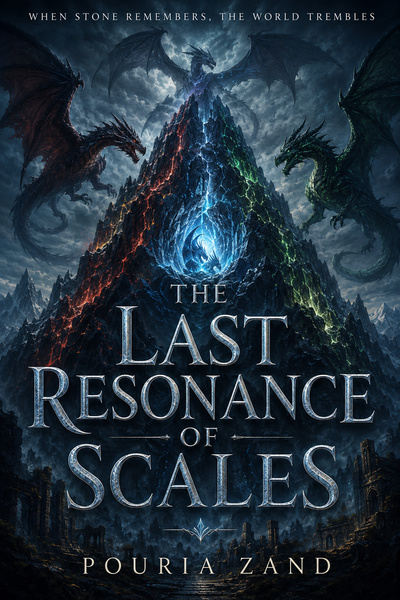
Chapter Three: III. THE SILVER SURGE
Part One: The Village of Mont Vala
Mont Vala clung to the northern shoulder of Mount Silverpeak like a scar that had healed but never faded. The houses were built from the mountain's own stone—not for beauty, but for survival. Each wall was three meters thick. Every window faced south, because the north offered only wind, and wind was nothing but a reminder of death.
But the people of Mont Vala were accustomed to death.
What they were not accustomed to was having nothing.
For generations, the village had produced only one thing: the silver-hued metal called Astria. A metal that welled up from the earth's core—not mined, not veined, not quarried. It surged. On certain nights of the year, the ground would split and molten metal, the color of a zealot's fever dream, would erupt from the depths. They called it the "Mountain's Tears."
With clay molds, the people caught those tears. Cooled them. Shaped them. And sold them to merchants who sailed from the south on ships whose very hulls were forged from the same metal—though no one knew it.
The finest grade of Astria—what they called "Living Silver"—was birthed only on the Great Surge Night, in the northern reaches of the isle, beneath the fortress of Mont Vala. This metal hung from cavern ceilings like luminous stalactites. Each stalactite was worth a fleet. Each fleet, a kingdom.
And the ritual of Surge Night was thus:
The entire village gathered in the main square. The elders lit lanterns of raw Astria—casting a blue-violet light that seemed to rob shadows of their will. The women sang in a tongue that only stone could comprehend. The children tasted the first droplet of the surge—not for flavor, but for the memory they would carry into adulthood. And then, the Reeve of the village would pluck the first stalactite with his own hands and raise it to the heavens—so the dragons might know that men were still not asleep.
---
Part Two: The Reeve and His Guests
That night, the Reeve of Mont Vala sat in his fortress.
His name was Lord Holderic. Fifty years old, but his hair was pure white—not from age, but from choice. Each white strand marked a sleepless night in which he had been forced to choose between one man's death and everyone else's survival.
His guests had come from the north.
Reeve Gardon, Warden of the Northern Territories. A man with a beard so thick it lay upon his chest like a fallen forest. Eyes the color of raw Astria. In his left hand, he always held a goblet; in his right, a quill. They said he wrote death warrants with the quill and toasted death itself with the goblet.
He had brought with him:
· Three sons—the eldest of whom we shall meet in due time.
· His wife, Lady Elsa—a woman who, when she spoke, hushed the entire hall, not out of respect, but for fear of losing a word that might never be heard again.
· Six guards, whose shadows fell upon the fortress walls like warnings.
Lord Holderic received them in the great hall. A table laid with mountain goat, barley bread, and wine aged in Astria vessels. But no one ate. Everyone waited.
Waited for the Surge.
---
Part Three: Gardon's Son, Kain
Kain, Gardon's eldest, was twenty years old, and in that entire hall, no one looked lower than him—except perhaps the stones beneath their feet.
His eyes were like two shards of dark blue ice that neither melted nor reflected—they only watched others melt. Black hair fell across his brow, so that when he lowered his head, no one could guess what he was thinking.
But that wasn't his defining trait.
Kain never smiled. Not from coldness—but because he considered smiles incomplete. He believed a smile was the pinnacle of weakness, because it meant something had made you happy—and anything that could make you happy, could also destroy you.
He was neither lover nor hater. He was an assessor.
Unauthorized reproduction: this story has been taken without approval. Report sightings.
And that night, he assessed something no one else had noticed.
During supper, his uncle—Darius, brother of Reeve Gardon—glanced at the wall clock three times. Once too many. Darius managed the Astria stores. He wasn't supposed to be in the fortress. He was supposed to be in the northern caverns, watching over the stalactites.
Kain said nothing.
He slipped out of the hall, unseen. Descended the spiral stairs of the fortress. Exited through the hidden door behind the kitchen—known only to the Reeve and his kin. But Kain knew everything. Because he always listened. And no one ever considered listening dangerous—until it was far too late.
In the northern caverns, beneath the filtered moonlight of Astria, Kain saw his uncle. Darius was lashing the greatest haul of pure stalactites—the ones meant for the Great Surge—to a boat that waited on the isle's hidden shore.
A southern merchant. A cargo worth three kingdoms. A betrayal.
Kain drew his bow—not of wood, but of bone from a small dragon he had found in the mountains years ago. He didn't aim. He had forgotten how to aim. He simply knew where the arrow would go. He always knew.
The arrow struck Darius in the back—not one, but two. The second was for certainty, not cruelty. Out of respect for finality. When Kain started something, he finished it. Even if the ending was the death of his own blood.
Darius fell without a sound. The stalactites shattered across his chest, casting a light that, for an instant, illuminated Kain's face. In that light, Kain smiled for a second.
The first and last time in his life.
Then he set the boat ablaze with a flaming arrow. Hid the body in a crevice of the cavern—where stone devours secrets. And returned to the fortress, as though he had only stepped out to relieve himself.
---
Part Four: The Morning of Decision
At dawn, the pale northern sun crept from behind the clouds, drowning Mont Vala in a gray light. But the people did not look to the sun. They looked to the northern shore, where the remains of the burnt boat lay like the bones of a sea giant upon the sand.
The cry of discovery woke the village.
Lord Holderic, with eyes that had not slept—because the Surge Night had passed and no stalactites had come—ran to the shore. Amid the ashes, he saw the melted stalactites. Wealth destroyed. A dream reduced to cinders.
Then they found Darius's body. With two arrows in his back.
Holderic returned to the fortress and, with eyes that still could not believe, turned to Reeve Gardon:
—Your brother betrayed us, Lord Gardon. He was selling the stalactites to southerners. Now he is dead.
Gardon—whose face was like cracked marble—was silent for fourteen seconds. Then he said:
—Remove his corpse from this place. And arrest his family. All of them.
The fortress soldiers, on Lord Holderic's orders and with Gardon's assent, dragged Darius's wife and children from their homes. The sobbing of children was the only sound heard in the main square. Gardon drew his sword and laid it upon the neck of his brother's wife—a woman who had not dared to meet his gaze for seven years.
But he did not kill her.
He lowered the sword and said:
—Go south. To where the name of Mont Vala is never spoken. If you return, I will choke the life from you with my own hands.
Then he turned to Lord Holderic:
—From this day, you are the new Reeve of Mont Vala. The fortress, the village, the caverns, the trade of Astria—all are yours. If you lose the next stalactite, you will find yourself in my brother's place.
And Lord Holderic, with eyes still dazed from the shock of sudden power, merely bowed his head.
---
Part Five: Exile and Uprising
Darius's family—his wife and four children—passed through the northern gate of the fortress. Each carried a small bundle of bread and cheese, and a threadbare blanket. The southern road was thick with dust and despair.
But not a kilometer from the fortress, a band of villagers—some thirty men—blocked their path.
Men with faces carved from old anger. One with a long beard stepped forward. His name was Orren, son-in-law to one of Darius's kin.
—Lord Darius betrayed us?—he shouted—Or were you the ones who betrayed him? We have endured thirty Surge Nights. Each of us has received no more than a finger's width of Astria as reward. And now a new lord? A man who doesn't even know which cavern births the finest stalactites?
The crowd swelled. Fifty. A hundred. Women and children emerged from their homes. Rebellion breathed in the air of Mont Vala.
Orren continued:
—Gardon has no army. The fortress guards number no more than thirty. His northern host is miles away. All it would take is—
But Darius, the exiled lord, cut him off. With a voice that trembled but did not break:
—All it would take is what? All it would take is for me to offer my own neck for a treason no one has proven? Did I kill my brother? Did I sell the stalactites? If I were a traitor, I would be seated in Holderic's place now—not outside this gate with four starving children.
He locked eyes with Orren:
—You want to rebel? Go ahead. My sword has not tasted dirt. But know this: a rebellion without a leader brings only massacre to the village. When Gardon returns with his army—and he will return—he will not choke just me. He will choke every last one of you with his own hands.
Orren spat upon the ground. Drew his sword:
—Then die, you coward of a lord.
The clash began. Swift and ugly. Darius drew his blade and struck Orren's neck with his first blow—right where he had been threatened. Orren's head rolled upon the ground, and the crowd recoiled for a moment.
But then they screamed.
Thirty. Fifty. Against one wounded man, four children, and a bloodied woman. Darius killed three and wounded four, but he bled from his side and shoulder. His wife, Elsa, felled two with stones she snatched from the ground. Their eldest son, Kay, barely twelve, sliced a man's leg with a kitchen knife.
But they were outnumbered.
They fled. Southward. Through jagged rocks and thornbushes. Elsa had a wound on her shoulder that exposed the bone. The youngest child, a four-year-old daughter named Mira, no longer cried—not from courage, but from sheer exhaustion.
And behind them, the shouts of the rebels echoed until midnight.
Darius did not look back. He looked only forward. At the mountain whose shadow, darker than ever, had fallen across the road.
And deep within that same mountain, something opened its eyes—something that had lingered in a half-slumber for thousands of years.
---
Part Six: The Awakening of Brasissis
In the deepest recess of Mount Silverpeak—where even Astria does not reach—a dragon awoke.
Brasissis.
Not the largest, but the keenest. His scales were not the color of stone, but the color of questions—each one an unsolved riddle. His eyes were like twin mirrors reflecting past and future simultaneously, though never clearly—so that none could be certain which they were seeing.
Brasissis did not lean upon himself. He rose from the ground without flapping his wings. Gravity, for him, was merely a suggestion, not a law.
Amid the caverns, on Surge Night, the mountain had birthed dozens of stalactites of pure, untainted Astria—stalactites that shone with a light not of sun nor moon, but of Alator's echo. The same light that stones, deep within the earth, had hidden in memory since the first detonation of the cosmos.
Brasissis, with a single breath, devoured all the stalactites. Not with his mouth—with will. Pure Astria, like mother's milk, was drawn into his scales.
He was sated.
And for the first time in ten thousand years, Mount Silverpeak trembled.
Not a geological tremor. A tremor of consciousness. The mountain was remembering that beneath its stony skin, something lived.
And that something was hungrier than ever.
Not for food. For answers.
Why did men steal Astria from the mountain's core? Why had none of the twelve dragons ever stopped them? And most critically: why did the Fourth Egg still fear to crack? Did not the dragon itself declare that "the time of emergence is at hand"?
Brasissis closed one eye—the right, which gazed upon the past—and opened his left fully.
Through the mountain's fissures, his gaze fell upon Mont Vala. Upon the fortress. Upon the southern road. Upon a family fleeing, with a wounded woman and a child who no longer wept.
And Brasissis, in the cavern's gloom, smirked—a smirk that set all the stones to laughing.
For he had seen that one of those humans carried something within them that even they did not know.
And that something smelled of an egg.
---
The silver bled. The mountain remembered.