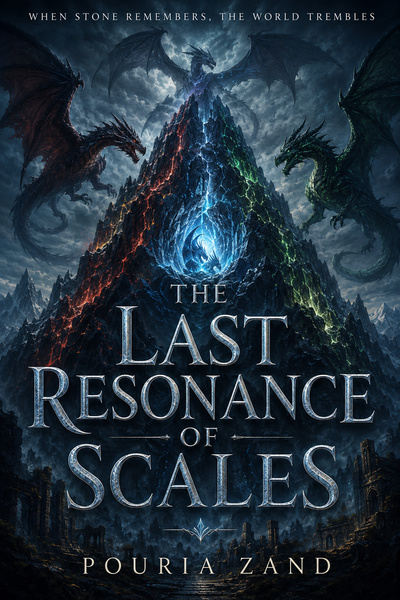
Part One: The Valley Where Fire Breathes
Deeper than any map drawn by human hands, buried in the heart of a mountain range whose name even the stones have forgotten, lies a valley called Kreitor-Zar.
A name from the proto-dragon tongue, meaning "The Cradle Where Fire Is Born."
The walls of this valley are forged from living obsidian—stone that still remembers the heat of its own birth. From its fissures, once every thousand years, sulfur geysers erupt to the height of mountains. Not for destruction—for breath.
Beneath this valley run veins of raw Astrion that have never reached the surface. This Astrion is called the Earth's Dream-Liquid, because the earth dreamed it before it knew itself.
And now—at the valley's heart, on a stone slab the size of a battlefield—lies the Fourth Egg.
No longer on the stone—but within it.
Beneath it, seven layers of basalt have melted and resolidified, as if the egg is taking root.
---
Part Two: The Dragons Arrive—Each with Their Own Roar
They came one by one. Not from the sky—because Kreitor-Zar does not accept the sky. The sky above this valley is molten—clouds of ash and vapor that would cook any bird before it entered.
They came from beneath the earth. Through tunnels they themselves had carved thousands of years ago with their fiery breath.
---
First: Sisa, the Frozen Queen
She emerged from a fissure in the eastern wall. Each of her scales was a fragment of a glacier that would not melt even in this heat. Her body temperature was so low that the air around her turned to snow. Her eyes—one galactic, one a hollow void—saw everything simultaneously from past and future.
Sisa spoke:
—"This valley… smells of birth. Not the birth of life—the birth of something that flees from language itself."
---
Second: Morinth, the Twofold Mother
She crawled from the western cave, through the dripping of toxic limestone. Her bifurcated tail—one flame of green despair, one flickering hope—divided the valley into two colors.
Morinth stared at the egg and said:
—"When I laid my eggs, I never knew which would survive. This egg… has devoured all my eggs within itself."
---
Third: Aroval, the Broken-Horned
The last to enter—and only because the egg drew him, not because he wished to come.
He rose from a hole in the valley floor, as if the earth had lifted him up. His three broken horns, like a crown of defeat, sat upon his tilted head. His glacial blue scales cracked in the valley's heat, but he showed no pain.
Aroval said, without opening his lips:
—"I have come to see what pulled me from isolation. If this egg is unworthy, I will commit it to fire myself."
---
Fourth: Brasicis, the Dragon of Questions
He was already in the valley. Seated on the central slab like a scaled hen brooding over her egg—but not for warmth, for listening.
His scales—each the color of an unanswered question—gleamed in the lava-light. His mirror-eyes—one to the past, one to the future—gazed simultaneously.
Brasicis spoke, with a voice that emanated from his scales, not his throat:
—"Welcome to the stone birthing-chamber. The egg is transmuting. Not growing larger—smaller. As if compressing itself to the size of a heart."
---
Fifth: Fargus, the Himalayan-Born
He arrived by falling—not flying. From the top of the wall, he hurled himself downward, so heavy that the earth had no pulse for seven seconds.
His blind left eye was closed. His right eye, like a small sun, illuminated the valley.
Fargus spoke, with a voice that issued from his neck-gland:
—"The smell of childhood… the smell of the first time the earth breathed… This egg reminds me of before death."
---
Sixth & Seventh: Golmorr, the Island-Back & Kerkosous, the Mountain-Spine
Golmorr did not come—he swallowed the valley. The island on his upper tooth appeared above the valley, and his shadow covered it entirely. He did not descend—only his colossal eyes stared at the egg through the cracks in the stone.
And Kerkosous… he did not enter—the valley formed around him. Because the mountain on his back was larger than the valley itself. So the valley, like a tight garment, wrapped itself around his form.
Golmorr roared:
—"This egg… its shadow resembles me. Meaning it is a rival. But… I have not yet decided whether to devour it or be a spectator."
Kerkosous, from the depths of his mountain, replied:
—"I have carried mountains to save eggs from snow. But this egg… is heavier than me. Not in weight—in meaning."
And suddenly, both, simultaneously, fell silent—because the egg, beneath the stone, pulsed. Once. So powerfully that the scales of Golmorr and Kerkosous, for a moment, became the same color.
---
Eighth: Zarin, the Trident of the Depths
He rose from a small hole in the valley's center, like a giant serpent. Three rows of teeth—each row from a different geological era—flashed in the lava-light.
Zarin spoke, with lips that had been closed for thousands of years:
—"The approach… the approach of the Fourth. Something has gathered around the egg that we cannot see. But I can feel it. Like the scent of familiar blood…"
---
Ninth: Azarkor, the Core-Born
He was the last to come—but from the lowest point.
The valley's center split open, and from the fissure erupted molten matter that was neither fire nor stone—something that boiled from the earth's core, with a color even dragon-eyes did not recognize.
Azarkor rose from that molten substance. His scales were not of stone, but of liquid iron. He had forgotten the number of his eyes—but all of them, simultaneously, stared at the egg.
He spoke, with a voice that came from the temporary collapse of liquid iron around his heart:
—"This egg… one billion years ago, I shattered it. And what emerged… was unnamable. Now it has returned. For retribution—or for completion."
---
Part Three: The Fifth Crack
Brasicis, as if he had been waiting for everyone, turned to the assembly and said:
—"When the egg took its first crack, the stones breathed. When it took its second, the law of gravity bent. When it took its third, silence smiled. The fourth crack… pushed time backward within a radius of one millimeter.
Now, while we are all here—
The egg has taken its fifth crack."
All the dragons, simultaneously, stared at the egg.
The fifth crack. But this time—no sound. No smile. No law that bent.
Just one sensation:
Hunger.
The egg was hungry. Not for food—for meaning. For purpose. For a reason to open.
Sisa stepped forward and said:
—"The egg wants to know why it should open. If we cannot give it an answer that convinces it… it will never open."
Morinth laughed, but her laughter was venomous:
—"So it has summoned us here to be witnesses to its own deadlock?"
Aroval, for the first time, stepped forward. And spoke, with a voice that issued from the fissures in his horns:
—"Perhaps the egg does not want to know why it should open. Perhaps it wants to know what it will lose if it does not."
Silence. Silence so heavy that the entire valley seemed to have become a single ear.
And then—the egg trembled.
Not a crack—a quiver. Like a fetus that, for the first time, has heard its mother's heartbeat.
---
Part Four: The Sky Battle of Aroval and Fargus—The Blood That Fed the Egg
In the midst of silence, Aroval suddenly spun and stared at Fargus.
—"You… you smell of dead stone."
Support the author by searching for the original publication of this novel.
Fargus, with his sun-like right eye, replied:
—"And you smell of fear. Not of the egg—of yourself."
Aroval roared—a roar that shook the valley:
—"I have not moved for two thousand years. And you… you claim to know why?"
Fargus spread his wings—each the size of a valley:
—"I know. Because I was once the same. I too once thought that if I did not move, life could not touch me. But life… life comes from within. Like the egg."
Aroval spread his wings—for the first time in two thousand years. And the sound of their opening was like the splitting of a continent.
—"Then come… show me what movement means."
---
The Battle in the Molten Sky
They leaped into the sky simultaneously. Not from the ground—from the laws.
Aroval, with his glacial blue scales, clapped his wings together and conjured a blizzard in the molten sky—snow that, upon contact with ash, turned to black crystals and shot toward Fargus like arrows.
But Fargus—with his Himalayan-rough scales—swallowed the storm. With open mouth, he drew the black snow into himself and then—through his neck-gland—expelled a fire not of ordinary flame, but of mountain-wrath.
Aroval dodged the fire—but his tail burned. For the first time in two thousand years, he felt pain. And the pain drove him mad.
He dove toward Fargus, smashing his broken horns into Fargus's chest. One horn pierced Fargus's breast.
Fargus roared—but not in pain. In laughter.
—"The last time someone hurt me… I don't remember. Thank you for reminding me what it feels like!"
Fargus, with his claws, seized Aroval's neck, and both, spinning, plummeted toward the ground.
Mid-fall, Aroval folded his wings and transformed himself into a rolling mass of ice that slammed Fargus into the valley wall.
Fargus, with one motion, freed himself and landed on Aroval's back with all his weight. Then—he drove his claw into the fissure of Aroval's third horn. The third horn—already broken—snapped completely.
Aroval screamed. Not in pain—in shame.
And in that moment, Fargus made one mistake: he smiled.
Aroval, in that same instant, twisted his head and drove the tip of his second horn into Fargus's right eye—the sun-like eye.
Fargus went blind. But before blindness took him fully, he raked his claw across Aroval's chest—so deep that his ribs showed.
Both, bloodied and wounded, crashed down. Directly onto the central stone—directly beside the egg.
---
The Battle's End
Fargus, with one bloody blind eye, collapsed on the ground, his breaths numbered.
Aroval, with a split chest and one fewer horn, knelt.
Sisa approached them and said:
—"As I said… the egg is hungry. You have fed it."
All looked. The blood of both dragons had dripped onto the egg. And the egg… absorbed the blood. Not that it spilled over it—but that it was drawn into it. Like thirsty skin.
For the first time, the egg took on color. The color of the blood of Aroval and Fargus—a silver tinged with red. A color no stone had ever seen.
And the egg spoke—not with sound, with pressure:
—"Well done… now I understand what sacrifice means. Continue…"
---
Part Five: Azarkor and the Volcano—Devouring Fire
While Aroval and Fargus lay fallen beside the egg, Azarkor slowly approached the valley's western wall.
There stood a dormant volcano—not dormant, but waiting.
Azarkor, with his molten-iron scales, stood before the crater. The smell of sulfur and melted stone filled his nostrils. The heat was so intense that the scales on the front of his body began to glow.
And he spoke, with a voice from the collapse of liquid iron:
—"I come from the earth's core. I carry primal magma in my veins. But this volcano… this is the earth's new interior. I have not tasted it."
Then—he opened his mouth. Not a mouth—a chasm the size of a valley.
And he swallowed the volcano. The entire thing.
Lava, stone, ash, and heat—all poured into Azarkor, like water reaching the thirsty.
In that same moment, the ground beneath him cracked. The valley walls, for the first time in a thousand years, trembled. All the dragons leapt back.
Azarkor's scales began to shine. The color they radiated was no longer liquid iron—it was liquid sun. A heat emanated from him that forced Morinth, the farthest dragon, to step back three paces.
Azarkor turned and looked at the others. His eyes—he had forgotten their number, but now all of them burned like hot stars.
He said:
—"Now I am the hottest. Not for power—but to fix your gaze upon me. See what I have done… and ask yourselves: Can I do the same?"
Morinth, who had trembled at the sight, said:
—"He is performing… but why?"
Sisa answered:
—"To attract the attention of the females. He wants to know if they will accept him as an equal, or regard him as a stranger from the core."
Zalara—a female dragon who had remained silent until now—said:
—"His acceptance… depends on the egg's decision. If the egg accepts him, so will we."
Azarkor looked at the egg—and the egg, in response, pulsed.
Once. As if to say: "I see you."
But this time, the pulse shattered the stone beneath the egg. A crack that began beneath the egg and reached to Azarkor's feet.
Beneath Azarkor's feet, the earth split—and for the first time, a vein of raw Astrion rose to the surface. Not silver, not blue, not white—the color of the egg's eye.
Azarkor, with his starry eyes, stared at it—and for the first time, fell silent.
---
Part Six: The Return of the Great Rhys of Mont Vala—The Crack of Mont Vala
On that same day, in the village of Mont Vala, Lord Holderik—the new Rhys—made his final decision.
At dawn, before the sun rose, he gathered all the villagers in the main square and said:
—"The Astrion… this year it boiled. But not like previous years. The stalactites that erupted from the earth's heart were colorless. Meaning the earth… no longer trusts us. Within five years, there will be no Astrion. We must return to the main fortress in the northernmost point of Mont Vala—where our ancestors first discovered the Astrion."
The people grumbled—but no one dared oppose him. Because Holderik, in his hand, held a stalactite of that same colorless Astrion—and in the morning light, it shone, but not silver, not blue, not white.
It shone like the egg's eye.
Holderik continued:
—"Take everything. Everything of value. And follow me. To the fortress of Nero-Dor—'House of the First Silence' in the ancient tongue."
And the caravan, half a league long, left Mont Vala fortress. With Holderik: his wife, two sons, three daughters, and sixty soldiers.
And among the crowd—the family of Darius? No. They were still wandering the southern road. But their shadow, upon the fortress stones, remained.
---
Arrival at Nero-Dor—Cold That Remembers Stone
The fortress of Nero-Dor, atop the northernmost peak, stood like a slab of stone watching the sky.
Its walls were of black obsidian that repelled the sun's heat in summer, and in winter, drew the cold inward so the walls could breathe.
Cain, Holderik's eldest son, the moment he entered, felt that something was wrong in this fortress.
The smell of ancient stone, the smell of history, the smell of things buried—all mingled and twisted through the corridors. The candlelight cast shadows on the obsidian walls that seemed alive.
Holderik said to Cain:
—"Search the fortress. Everything. Every room, every cellar, every tower. I want to know if, in our absence, something has entered."
Cain, without a word, nodded and went into the fortress.
---
Part Seven: Cain, the Frassuis, and the Secret of the Physician's Room
The Frassuis Birds—Gazes That Judge
Instead of taking the main stairs, Cain entered through the hidden passage behind the kitchen—the same passage built years ago for escape from northern raids.
The passage was narrow and smelled of mold and dry earth. Its granite walls bore deep cracks from the passage of time. The torchlight cast tall, crooked shadows on the walls that seemed to move independently.
He reached the Bird Tower—a tower at the fortress's summit with three large cages. In each cage, a Frassuis.
These birds, with wings three meters long, dark green feathers, silver chests, and beaks of Astrion itself, were the wildest predators of Mont Vala.
They stared at Cain with their black, emotionless eyes. Their gaze was heavy—not just the gaze of birds, but of something with millennia of memory.
Cain, with hands that never trembled, gave them three pieces of lamb meat.
The Frassuis snatched and devoured the meat. One of them—the largest, named Vark—then stared at Cain, as if to say: "Now it's your turn to feed me… or you will be the food."
Cain smiled—a smile no one saw. But in Vark's eyes, something sparked. Not recognition—identification. As if Vark knew that Cain carried something in his chest that even he himself did not know.
Then, suddenly, from the floor below, came the sound of moaning. Not ordinary moaning—the moaning of labor.
---
The Physician's Room—Amid Sweat and Secrets
Cain, making no sound, descended the tower's wooden stairs toward the physician's room. The wood creaked beneath his feet, and the smell of dust and lamp oil hung in the air.
He opened the door with the tip of his boot.
Inside the room, three people:
· The fortress physician, an old man with white beard and trembling hands. Sweat dripped from his forehead onto the wooden table beside him, where old surgical tools lay arranged.
· A young handmaiden, with tearful eyes, holding bloodied cloths. Her dress was wrinkled and faded, as if she had not slept through the night.
· And a woman lying on a stone slab—sweating, pale, and in labor.
The room smelled of blood and sweat and herbal medicines. A single candle's light fell upon the woman's face, deepening the lines of her pain. The stone walls were damp, and in one corner, the shadow of a shelf full of dark glass bottles lay cast.
The woman's pain was so intense she could not scream—only short, rapid breaths that turned to vapor in the cold air.
Cain, with his cold blue eyes, looked at the handmaiden and said:
—"Who is this woman?"
The handmaiden trembled—so hard the glass beside her rattled:
—"M… my lord… she is a traveler who…"
Cain, in a lightning movement, drew his dagger and placed it against the handmaiden's throat. The blade gleamed in the candlelight, casting a sharp shadow on the wall.
—"If you lie, you die here. Tell the truth: who is this woman, and why is she giving birth in my fortress?"
The handmaiden wept—not from fear of death, but from fear of scandal. Her tears flowed over her thin cheeks:
—"She… she is your father's concubine… Lord Holderik brought her from Silver-Mont… and this child… is his own… meaning… he is your brother…"
The dagger, for a moment, pressed harder against the handmaiden's throat. Cain, suddenly, remembered the smell of his uncle's blood—the same blood that had dried on his hands.
Then—he lowered the dagger.
His eyes, for the first time, were not cold, but black. Black like obsidian, black like that shadow he had seen above the valley.
He said nothing.
He only looked at the laboring woman—and then at her belly. The woman, with eyes filled with pain and terror, looked at Cain. In her gaze was pleading—not for her own life—for the infant's.
Cain, without a word, left the room.
But in the corridor, he stopped. He looked at his hands. The hands that had killed his uncle. The hands that could also kill this woman and the infant.
And in his chest—something pulsed. Not a heart. Something else. Something scaled. Something egg-like.
Cain, for the first time, felt that something within him was awakening.
---
Part Eight: The Great Hall—The Hidden Execution
The Next Day—A Hall Where Lies Breathe
The great hall of Nero-Dor fortress was filled with lords, knights, and notable villagers.
The ceiling was so high that daylight barely reached its peak. The walls were covered with ancient tapestries and carvings telling the story of the first Astrion discovery. The smell of wax and leather armor hung in the air.
Holderik sat upon his obsidian throne. The throne was carved from a single piece of black stone, and at its lowest point was a deep crack—the same crack they said had been left from the first Astrion.
Before him, the physician and the handmaiden, chained, knelt. The physician, with his white trembling beard, stared at the floor. The handmaiden wept—but her voice was lost in the hall.
Cain stood in a corner of the hall—and his gaze was not on his father, but on the laboring woman, who hid behind the columns with an infant in her arms.
Holderik spoke, his voice echoing through the hall:
—"These two… are accused of treason against the fortress. They secretly brought a woman in—and now that woman and her child are both dead."
Silence. So heavy that the breaths of the lords were audible.
Holderik continued:
—"I order that the physician and handmaiden be imprisoned in the dungeon until it is determined why they committed this crime."
Cain, in that same moment, stepped forward.
The sound of his footsteps on the stone floor echoed like the pulse of a second heart.
All eyes turned to him.
He spoke, his voice carrying through the hall, but cold—cold as a glacier that has decided to speak:
—"That woman… was not killed. I saw her. Last night. In the physician's room. She was giving birth to a child. And that child… is breathing."
The hall erupted. Lords looked at each other. Whispers, like a wave, passed through the room.
Holderik, for the first time, went pale. His hands, on the throne, began to tremble.
Cain continued:
—"Father… why do you lie?"
---
Part Nine: The Confrontation of Father and Son
The Truth That Split the Hall
Holderik rose from his throne. His face, like stone beginning to crack, met Cain's gaze.
—"My son… you do not understand."
Cain, with eyes like two pieces of dark blue ice, replied:
—"What do I not understand? That you killed your concubine to avoid scandal? Or that you killed your child so I would have no rival for the throne?"
Holderik, with a trembling voice, said:
—"That woman… whether she lives or dies… is dangerous to the fortress. She came from Silver-Mont—a city that has made a pact with the dragons of Kreitor-Zar. If it is known that I had relations with her, the dragons… will raze the entire fortress to the ground."
Cain laughed. A laugh that echoed through the hall—and no one had ever seen Cain laugh. His laughter was dry and bitter, like the splitting of stone.
—"So you killed your concubine and child to save the fortress? Or to save yourself?"
Holderik strode toward Cain and struck him hard across the face. The sound of the slap, in the great hall, was like the crack of an arrow.
The hall fell silent.
Cain, with a reddened cheek but eyes still cold, said:
—"I will not kill you, Father. Because if I kill you, I will take your place and do exactly what you did. But know this… from today, I am no longer your son."
Cain turned and left the hall. Behind him, the murmurs of the lords rose like the buzzing of flies.
Then, in the corridor, he walked toward the room where the woman and infant were hidden. The corridor was narrow and dark, and the only light came from a small opening in the ceiling that revealed dust in the air.
He opened the door.
Inside the room, the woman—with tearful eyes—held the infant in her arms. The room was cold and smelled of dampness. A worn blanket was spread on the floor, and beside it sat a half-drunk bowl of water.
Cain said to her:
—"Leave the fortress. Now. There is a horse in the eastern stable. Ride south. To the village of Val-Tris. No one will know you there. Raise the child. And never tell anyone who his father was."
The woman, without a word, rose and left. In the corridor, she paused for a moment and looked at Cain. Her gaze held something she could not express—perhaps gratitude, perhaps fear, perhaps sympathy.
Then she vanished.
Cain, alone, remained in the room.
And for the first time—he neither smiled nor wept.
He only looked at his hands.
The hands that had killed his uncle. The hands that could also kill his father. But hands that had decided to stop their own fall.
He whispered, in a voice no one heard:
—"Egg… are you also deciding? Whether to open or not?"
And in that same moment—in the valley of Kreitor-Zar—the egg took its sixth crack.
Not upon itself—upon the stone beneath it.
Beneath the egg, the stone began to pulse, like a second heart. The pulses were so strong that the valley walls trembled one millimeter with each beat. The underground lava erupted more violently in response.
And in the fortress of Nero-Dor, Cain suddenly experienced a sensation he had never known:
The sensation that something in his chest was pulsing in unison with the egg.
He placed his hand on his chest. Beneath his skin, something hard, something scaled, something the size of a walnut—pulsed with each pulse of the primary egg.
And in the darkness of the room, Cain understood, for the first time, what he had become:
He was the host of the egg.
---
Part Ten: The End of the Beginning
As night fell over Nero-Dor fortress and Kreitor-Zar valley, three things happened simultaneously:
---
First: In the valley, the egg began to transmute.
It was no longer ovoid. It was elongating—as if becoming the shape of a spear. Or perhaps a bone that no skeleton needed.
Brasicis, with his question-scales, said:
—"The egg is choosing its form. Not the form of birth—the form of its own death. It is deciding what to destroy so it can be born."
Sisa, with her galactic eyes, suddenly leapt back:
—"The egg… is beginning to smell of human."
All looked at each other in horror.
The egg was humanizing. On its silver-red surface, lines appeared—lines resembling a human face, but not a complete face—fragmented, like a reflection in disturbed water.
---
Second: In Nero-Dor fortress, Cain sat on the floor.
Not from exhaustion—from the sensation in his chest. So powerful that his knees buckled and he sat on the cold stone. The stone was so cold it sent chill through his clothes to his skin.
He placed his hand on his chest. And beneath his skin, exactly where his heart should be, something pulsed that was not a heart. Something hard. Something scaled. Something that resembled an egg, but small, the size of a walnut.
And that thing—pulsed with every pulse of the primary egg.
Cain, with eyes that for the first time were not cold, but filled with horror, whispered:
—"I… I carry the egg within me?"
And in response, the egg within his chest pulsed once more—this time, with a beat whose meaning Cain understood clearly:
"Yes."
---
Third: In the sky above Kreitor-Zar valley, a shadow appeared.
A shadow that was not of dragon, not of bird, not of cloud. A shadow of something that had not yet taken form, but was gathering.
Zarin, with his three rows of teeth, stared at the sky and said:
—"The approach… the approach of the Fourth… but this time… the Fourth comes from above."
All the dragons looked at the sky. The ash clouds suddenly split in two—not by wind, but by pressure. Pressure that came from above, like an invisible hand rending the sky.
And in the heart of the shadow, something gleamed.
Something like an eye.
But not a dragon's eye, not a human's eye, not stone's eye.
The eye of what had opened the egg, one billion years ago.
And now it was returning.
To see if the egg, the second time, would open correctly or not.
The eye blinked.
And in that same moment, in Nero-Dor fortress, Cain—who sat on the floor—felt that something from above was looking at him.
Not through the ceiling—through the within.
The eye of the shadow saw Cain through the egg within his chest.
And Cain, in response, with his cold blue eyes, stared at the ceiling and spoke, with a trembling voice:
—"Who… is there?"
No answer came.
Only the shadow, in the sky above the valley, smiled.
Not with a mouth—with light.
Light that emanated from its eye and illuminated the entire valley—light that was not of sun, not of moon, not of star.
Light from before time.
And the egg, beneath that light, took its seventh crack.
A crack not on the egg's surface—but on reality itself.
---
Cain, in the dark room of the fortress, placed his hand on his chest.
The egg within him pulsed more slowly than before—but with each pulse, Cain saw images that were not his own:
The image of Kreitor-Zar valley.
The image of dragons gathered around the egg.
The image of the shadow's eye.
And the image of the face imprinted on the egg—a face that Cain, unconsciously, recognized.
His own face.
The egg was forming in Cain's image. Or perhaps Cain was forming in the egg's image.
And in the sky above the valley, the shadow's eye blinked for the second time.
And this time, it smiled.
Not with light—with silence.
A silence that said:
"Prepare yourself. The birth… is near."
__
"In the valley, the egg took Kain's face upon itself. In the fortress, Kain felt the egg's pulse in his chest. And in the sky, an ancient eye watched them both—and for the first time in twelve thousand years, the shadow doubted whether this time, the egg would not break open—but break the world instead."