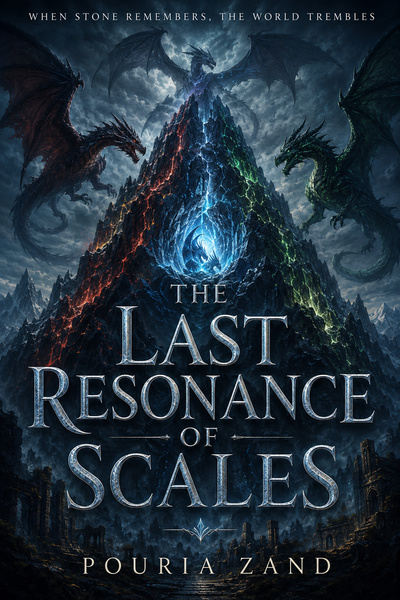
I
The three veins of quartz—red, green, colorless—no longer trembled.
They breathed.
Their breaths were short. Irregular. Like someone who, after a thousand years of drowning, suddenly remembers what lungs are for.
At the lowest point of the central fissure—where even falling comes to an end—the egg had taken its third crack. No sound. No light. No tremor. Just a sensation that passed from stone to stone, from quartz to quartz, from message to wound:
"The air is running out. Not for me. For all of you."
The stones understood this. And for the first time in the history of geology, granite felt fear. Not of the egg. But of what was inside the egg, learning how to open.
---
II
Seven hundred years. For seven hundred years, Sissa had slept beneath a frozen sea. Not in the ice—in place of it. Her body was so cold that the water around her remained solid without freezing.
But now—she opened her eyes.
The first: a dying galaxy. The second: a hole where the pupil should have been, collapsing inward.
She did not open her mouth. She had no larynx. She sent her voice through the respiratory vents on her neck, to the seven other dragons scattered across the continents:
—Whose scent do I smell?
The answer came from three thousand miles away, from the mouth of Kerkusos—the dragon who carried a mountain on his back without the mountain ever noticing:
—You smell of an egg. An egg that belongs to no one. And to everyone.
For the first time in seven hundred years, Sissa almost smiled. Because she had forgotten how to smile. But something like a smile twisted through the ice above her head—and the ice, without melting, cracked.
---
III
In the northern hemisphere, where maps read "Open Ocean," an island floated. It had no name. But the local inhabitants—deep-sea fish that had never seen light—called it "The Lipless Jaw."
Beneath that island, Gulmer opened his mouth.
The island was his tooth. He breathed once every three thousand years. Each time, a new island grew on his lower jaw. Now—for the first time in the sixth cycle—his upper jaw itched. Not a skin itch. An itch of foreknowledge.
Gulmer sent no message. He had no larynx. No brain. Only an instinct, two kilometers thick, carved into his bones:
"Soon, something will pass above me whose shadow will remind me of myself."
The island—his tooth—shifted one millimeter. Tsunami waves reached a supermarket in Japan and emptied the soda shelf. No one understood why. No one understood that that wave was a message: "I am ready. But I don't know for what."
---
IV
In a cave beneath the Great Sahara—not sand, but the ash of dead dragon bones—the oldest of them lay sleeping. A dragon who had even forgotten his own name. But one thing he had not forgotten: the scent of the egg.
And now—his eyes (seven of them, all on one side of his face) opened. Simultaneously.
His voice did not emerge from his throat. It escaped through the gaps between his scales—gaps that no one knew were not for breathing. They were for listening to the pulse of stone.
—The egg breathes. The egg is preparing to open. Not like a chick. Like a door. A door behind which all of us have forgotten what is imprisoned.
He pulled himself upright. For the first time in five thousand years. Each scale made the sound of a continent's bones breaking—not loud, but deep, so deep that only the other dragons heard.
And what they heard set them in motion.
---
V
That night—if "night" exists at the bottom of the ocean, beneath ice, beneath continents, and inside fire—twelve dragons simultaneously thought of two things: the egg. And themselves. And then, without exchanging a single word, without drawing a single breath—they voted.
Not democracy. Not choice. Something older: survival instinct disguised as a ballot.
---
Eight dragons said: Let it open.
· Sissa (beneath the southern ice): "The egg is the only thing that has ever surprised me."
· Kerkusos (the mountain-bearer): "The egg is heavier than any mountain I have carried. Heaviness means significance."
· Voldern (the sender of signs): "I sent the sign. The sign reached the egg. Therefore the egg belongs to me."
· Morinth (beneath fresh waters): "All who have drunk from my water await a miracle. Perhaps the egg is that."
This story has been taken without authorization. Report any sightings.
· Fargus (beneath the Himalayas): "I have slept enough. Waking without purpose is a slow death."
· Zarin (eleven kilometers deep in the ocean): "I sense proximity. Closer than ever."
· And two other dragons—whose names stone had swallowed—voted without words. Stone recorded their votes as "silent yes."
---
Three dragons said: Let it remain closed.
· Aroval (in the mountain's heart, with broken horns): "I do not wish to move even to fold my wings. The egg means movement. Movement means pain."
· Gulmer (the lipless jaw): "What comes from above, its shadow resembles me. That means it is a rival."
· Azarkor (the dragon of Earth's core—where liquid iron breathes—so named if anyone dares to name him): "Do not open the egg. Because I have already opened it. And what came out—was not something that could be named. Only something that eats names."
---
One abstained.
The oldest. Seven-eyed beneath the desert. (If one whispers his name, the stone swallows the whisper—but some of the most ancient scales call him "Father of Bones.")
—I know the egg. But I do not know whose it is. So I do not vote. I only watch. And I tell the stone: be ready. Because when the egg opens, stone will no longer be stone.
He did not finish. Because there was no word for that "something." And when there is no word, even dragons fall silent.
---
VI
At the very moment the vote ended—eight in favor, three against, one abstaining—the egg inside Silverpike Mountain… laughed in all their faces.
Not metaphor. Literally, a crack in the shape of a smile appeared on its shell. And from that smile, no sound emerged—but all twelve dragons, simultaneously, tasted something.
The taste of burnt sugar. With an aftertaste of blood. And the aftertaste of something that recalled a first kiss—for those who had been kissed, and for those who had only watched others kiss and understood they would never experience it.
The fourth crack—not on the shell. In the laws of physics.
For one moment, within a millimeter of the egg's surface, gravity reversed. Stones fell upward. Drops of water flew downward. And then—the law returned. But the egg had learned that it could bend laws.
Morinth raised her voice for the first time in three thousand years:
—This egg… does not preserve laws. It interprets them.
Voldern blinked:
—Interpretation means rebellion. Rebellion means we have grown old.
And something in the silence that followed—perhaps the silence itself—confirmed that both of them were right.
---
VII
At a depth of eleven kilometers in the Pacific Ocean—where pressure is so immense that genes themselves shatter—Zarin sensed what the others had not.
Proximity.
Not proximity to the egg. Proximity of a fourth. A fourth that was not inside the egg. A fourth that gathered around the egg, like vultures whose shadows arrived before they did.
Zarin opened his mouth—a mouth with three rows of teeth, each row belonging to a different geological era—and murmured:
—We think we have summoned the egg. But the egg has summoned us. To a feast where—
He stopped. Because a wave from the egg's surface struck the left corner of his mouth. The taste of that wave: the fear of a being that does not know what fear is.
For the first time in two thousand years, Zarin retreated. Not from fear. From respect for something not yet born, yet knowing how to convince stone—not through force, but through a logic stone cannot understand, yet feels is true.
---
VIII
And here—precisely at the chapter's midpoint—the story shifts from discovery to action. Not with a single decision. With three simultaneous decisions, in three different points of the world, none knowing of the others.
---
First: The Awakening of Fargus.
The dragon who slept beneath the Himalayan range—not in stone, but in place of stone—opened his right eye. His left had been blinded millions of years ago in a war fought over the proper way to breathe. Not over territory. Not over food. Over this question: "Should dragons breathe, or should they forget breathing?"
Fargus did not speak. Only a gland at the back of his neck activated. It began secreting a fluid that smelled of childhood—a scent no dragon ever forgets, because they were never children themselves. They had either been eggs or dragons. They knew childhood only by its scent.
Fargus made his decision. Not with words. With motion.
—I move toward the egg. Not to protect. Not to destroy. To see how something that reminds me of myself surpasses itself.
The ground beneath the Himalayas subsided by half a millimeter. No catastrophe occurred. But the premonition of catastrophe did—and sometimes premonition is more terrifying than catastrophe itself, because you can still flee.
---
Second: Gulmer's Mouth Closes.
The island atop Gulmer's jaw—the "Lipless Jaw"—suddenly split in two. Not from an earthquake. From Gulmer closing his mouth. For the first time in three thousand years.
And between the two halves of the island, something was found that no map had ever recorded: a bone. As long as a city. With engravings in a language not yet invented.
On the bone was written (if one could read it):
"This is not the fourth egg. This is the memory of the fourth egg. The egg has forgotten what it was. The bone remembers. Give the bone to the egg so that the egg may know itself—before something else knows it and gives it a name that cannot be taken back."
Gulmer did not swallow the bone. He kept it in the folds of his tongue—where he stored tastes. The taste of the bone: the grief of a mineral never excavated.
---
Third: Sissa Emerges from Beneath the Ice.
Not through force. Through inexplicable melting. The ice above her head melted—without heat. The water turned to vapor—without temperature. The vapor turned to cloud—without wind.
For the first time in seven hundred years, Sissa saw the surface.
Her first words (through the respiratory vents on her neck):
—The sky… tastes of egg.
Above, a bird passed by her and instantly aged, died, and became a fossil—merely from the weight of Sissa's gaze. Not from cold. From the weight of being seen by something that had seen nothing for so long.
The Queen Beneath the Ice opened her wings. Each wing the size of a province. On each scale, a closed eye. All the eyes opened simultaneously. Two thousand eyes. All fixed on Silverpike Mountain—not to see, but to be seen.
---
IX
Inside Silverpike Mountain, the oldest dragon—Father of Bones—finally finished speaking.
He rose. His scales opened like the pages of a book—a book whose every page recorded an era of extinction.
He said:
—The vote is over. But the egg does not care about the vote. The egg awaits something else: sacrifice. Someone must go inside the mountain. Place a hand on the egg. And accept that the egg will ask for something that cannot be returned. Memory. Or future. Or name. Or a piece of death you have not yet used.
Silence. A silence so heavy it could be weighed—approximately seventy thousand tons, if anyone wished to know.
Then Voldern said:
—I will go.
Not loud. Not firm. Quietly. As if speaking to himself.
Morinth said:
—I will too.
With a voice that tried to sound indifferent but was not.
Aroval—still in the mountain's heart, still wings folded, still bearing his broken horns like a crown—said:
—I will not go. But for the first time… I wish I would.
And the story—which until now had breathed like an archetype—suddenly forced its characters to choose. Not between good and evil. Between going and remaining in a story that no longer belonged to them. Because from this moment onward, the story belonged to the egg. They were merely living narrators who did not know they were being narrated.
---
X
Inside Silverpike Mountain, the egg took a deep breath.
Its breath escaped through the central fissure and traveled to the next continent, where it became a wind that pushed calendars forward by a month. In a distant city, a cow gave birth to twins. A child dreamed she was speaking a language she had not yet learned. An old man, at the moment of death, smiled instead of fearing—because something in his bones understood what his brain could not: that death was only a habit, and he could have quit the habit at any time, but had chosen not to.
And amid all this—the egg took its fifth crack.
This time there was sound. A sound like "Bismillah ir-Rahman ir-Rahim"—but in a language not even angels understand. Only stone understands. And stone, for the first time, answered:
"Answered."
Not in sound. In silence so complete that the universe seemed to hold its breath.
---
XI
And at this very moment—on the threshold between chapters two and three, between decision and action, between egg and birth—Sissa, Fargus, and Gulmer, all three, simultaneously and without coordination, took one step toward the mountain.
Their steps were different. Sissa slid on ice—but the ice beneath her was not there, it was water that turned to ice only to support her foot. Fargus did not step—he threw himself forward, like a shadow fleeing its owner. Gulmer did not move at all—he threw his island forward, with himself on it.
But the result was one:
Silverpike Mountain, for the first time in its history, cast a shadow.
Not a shadow on the ground. A shadow on time. Meaning, in some parts of the world, the sun set earlier. In some parts, night came later. And no calendar could explain the discrepancy—because calendars are built for events that have already occurred, not for things that are in the process of occurring.
---
XII — New Sequence (Bridge to Chapter Three)
At that very same second—beneath seventy million tons of rock, in a chamber no map had ever recorded—Azarkor, the dragon of Earth's core, brought out something he had hidden from all twelve dragons.
A scale.
Not his own scale. The fourth one's. The very same that had opened the egg before. A billion years ago. Before stone learned to shatter. Before death was invented.
The scale crumbled in his palm (if dragons have hands). Turned to dust. Dust turned to smoke. Smoke turned to a sound—sound to a word. The word was:
"Come."
For the first time in his history—Azarkor neither moved. Nor breathed. Nor spoke.
He listened.
And from deep inside the egg—from beyond its shell, beyond its cracks, beyond the laws that had bent—an answer came. Not for the ear. For the bone. Not for the mind. For something older than mind:
"You came."
Azarkor closed his eyes. (How many eyes? It did not matter. He had forgotten their number.)
And he said—not with sound, but with the temporary collapse of the liquid iron around his heart:
—Then it was my fault. The first time. And it is my fault. This time.
Then he folded his scales. He moved upward from Earth's core. Not swimming. Not flying. Forgetting gravity—just as the egg had taught.
And at the surface—directly beneath Silverpike Mountain—the earth did not split in two for a second.
It only reminded itself that it could.
And that reminder was enough to awaken something inside the egg.
The egg breathed. Deeper than ever before. So deep that rocks lost their pulse. So deep that the quartz changed color—red to black, green to white, colorless to an eye that stared at what the egg was seeing within itself.
And what the egg saw within itself:
A serpent. Not of scale. Not of flesh. Of question. A serpent whose shape was "Why?" and whose movement was "What if?" and whose breath was "Not yet."
The serpent within the egg opened its eyes.
And the egg—for the first time—felt fear.
Not from without. From within.
---
End of Chapter Two
---