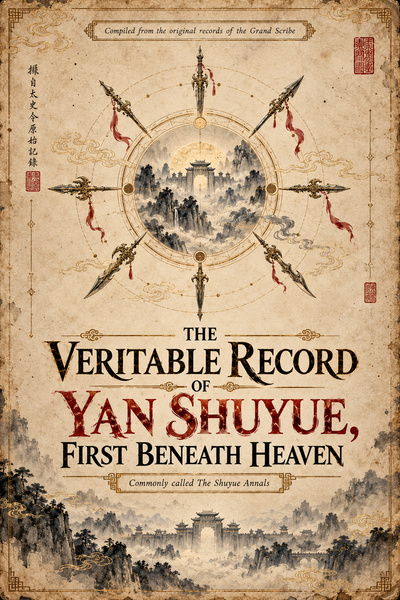
Chương 1
BOOK THE ONE HUNDRED EIGHTY-SEVENTH - OF THE DESCENT, RECORD I
BOOK THE ONE HUNDRED EIGHTY-SEVENTH
OF THE DESCENT
RECORD I: Concerning the Opening of Heaven Above Xun, the Gathering of the Seventy-Three Banners, and the First Descent
I write this account before the blood upon the Plain of Xun has dried, and while the wound in Heaven remains visible from the western windows of the capital. The bells have not ceased. The wounded continue to arrive through the outer gates.
Three fires burn beyond the southern wall, though whether they consume houses, storehouses, or merely the grass of the plain I cannot presently determine.
Of the number dead I shall say nothing until the registrars have completed their work, and of the number descended from the upper realm I can give only estimates, for any man who claims to have counted them accurately while they were falling from the sky in their thousands should not be trusted with arithmetic.
What follows is therefore not the settled account of an event already passed into history. It is the record of what I saw, what I was near enough to hear, and what I have since been able to confirm in the few hours afforded me. Where certainty is impossible, I shall say so.
Where I was absent, I shall not pretend otherwise. Where Yan Shuyue behaved foolishly, I shall likewise say so, though I expect objections from her when she eventually reads this.
At the eleventh hour on the ninth day of Long Rain, Heaven opened above the Plain of Xun.
I use the word opened because I know no better one. It did not break like glass, nor part like cloth, nor unfold like a gate, though all three comparisons were made within the first hour by men who should have known better than to become poets during an emergency.
The first sign was no wider than a thread: a line of pallid brilliance extending across the upper sky from north-east to south-west, so fine that ordinary eyes upon the streets below might not have perceived it at all. Those upon the western towers did.
The capital's great ward reacted before any human alarm was given.
Every inscription cut into the outer wall brightened simultaneously; the bronze guardians above the West Meridian Gate turned their heads toward Xun without being commanded; the nine spirit-measuring pillars of the Imperial Observatory cracked along their upper thirds; and all birds within perhaps ten li of the western quarter rose at once and fled east.
Then the clouds nearest the line were drawn toward it, not as mist is drawn by wind but as loose silk might be drawn through a narrow ring, and the line widened sufficiently that another sky became visible beyond ours.
I had seen other heavens before.
That statement requires explanation, but not here.
It is sufficient to say that I recognized at once what many upon the wall required several minutes to understand: the blue visible through that opening was not our blue, the qi pouring from it was not the qi of our world, and whatever had made the passage had done so deliberately.
I therefore sent a message to the Observatory, though by the time the messenger departed its masters had already reached the same conclusion. The Ninefold Alarm began soon after.
The first bell sounded from the Palace of Harmonious Measure. The second was taken up by the imperial towers. Within a dozen breaths every temple bell, sect gong, district drum, military bronze, and emergency chime in the western capital had joined it.
The Ninefold Alarm had not been sounded in my present lifetime. Most citizens knew it only from school texts, memorial inscriptions, or the complaints of elderly instructors who insisted that younger generations had become incapable of responding properly to catastrophe.
They were proven correct. For perhaps half an hour the streets produced every possible response except order. Merchants shuttered stalls, reopened them to retrieve money boxes, shuttered them again, and then abandoned both.
Carriages attempted to travel east while military columns forced their way west. Several district magistrates displayed admirable competence; others discovered that authority shouted loudly does not thereby become effective.
The poor moved first, which is generally what happens when a city is threatened, because the poor possess fewer servants to delay them with packing. The wealthy followed with furniture.
Shuyue had sent for me that morning.
She had not told me why.
This was not unusual enough to deserve remark at the time.
I found her upon the northwestern wall shortly before the opening widened, standing upon a merlon with one boot on the stone and the other upon the bronze head of a warding lion which the artificers had repeatedly asked people not to climb. She wore black. Her hair was bound high and carelessly.
At her waist hung two swords of different lengths and different schools, neither of which had been made for her. A narrow case containing throwing blades was tied behind her right hip.
She had brought a long spear wrapped in dark cloth, though she had left it leaning against the wall behind her, and a chain of black iron was coiled twice beneath her sash. There were other weapons upon her person which I did not identify until later. This too was customary.
Yan Shuyue was fifty-nine years old that morning and had been cultivating for forty years.
In those forty years she had acquired more names than were useful. Among martial circles she was called the Thousand-Armed Asura.
Court memorials increasingly referred to her as Sovereign of Ten Thousand Weapons, though she disliked this and had once returned an imperial document because the title made her, in her words, “sound like a warehouse.”
Beyond the capital she had other names, some grander and some less printable. Of these, the simplest had lately become the most common.
First Beneath Heaven.
It is difficult to explain such a title without sounding as though one has already surrendered judgment to legend.
I shall therefore state only what was generally understood before the events of this day: no cultivator presently known within our lands had defeated her in single combat for seven years; no weapon had yet been placed in her hands which she could not use; and of the twelve persons commonly proposed as her nearest peers, five had lost to her personally, three refused further challenges, two were her friends when convenient, one was dead, and one continued to insist the question remained unresolved.
The opening in the sky widened.
Shuyue looked upward for some time.
“What do you think?” I asked.
“Trouble.”
This was not among her more useful observations.
“What kind?”
She tilted her head as the foreign qi descended upon us. It came in waves by then, pressing against the city's great ward so heavily that the upper inscriptions had begun to hum. The air smelled of frost and iron although the day was hot. Several cultivators standing farther along the wall had begun circulating qi merely to remain comfortable.
“The expensive kind,” Shuyue said.
Then the first man descended from the other Heaven.
He came alone.
He wore white armor with silver plates along the shoulders and thighs, and behind him revolved six swords whose blades never touched his body. He descended upright through the rift as easily as another man might step down from a carriage. The clouds parted beneath him. When his foot passed fully into our Heaven, the pressure of his qi struck Xun.
The plain sank.
I do not mean that men staggered beneath spiritual force. I mean the earth itself depressed beneath him in a broad circular hollow. Grass flattened for almost a li. The nearest irrigation channel burst its banks.
The old watchtower upon the southern rise split along one wall, and several dozen unprotected soldiers fell where they stood. Three horses died immediately. A line of imperial banners bent almost level with the ground.
The man remained perhaps two hundred zhang above the plain and looked down.
By then the first formations of the empire were already moving into place below him.
It would be pleasant, and false, to say that the seventy-three banners gathered at Xun represented a unity of purpose previously prepared for such a day. They did not.
The empire had spent most of the preceding decade proving itself capable of sustaining several political, commercial, sectarian, doctrinal, and personal disputes simultaneously, and many of those who arrived upon the plain had attempted to kill one another within recent memory.
The Azure Dragon Sect took the eastern rise with the Nine Rivers School, whose elders had denounced three Azure Dragon training manuals in public only the previous year.
The Temple of Boundless Mercy established its healing wards beside the Red Lotus Society, presently prohibited in four provinces and tolerated in the capital chiefly because arresting all of its members would have required an army which was currently needed elsewhere.
The Golden Reed Pavilion raised its black-and-gold standard less than half a li from Shuyue despite the fact that its present master had sworn upon his ancestral altar to kill her.
Madam Luo Jinzhi of White River arrived at the head of six hundred swordsmen and did not greet Shuyue, which constituted a marked improvement over their last meeting. Three imperial legions formed the center.
Great clans, lesser sects, city schools, temple orders, independent masters, foreign guests, criminal associations temporarily transformed by necessity into patriotic organizations, and cultivators whose affiliations I still do not know filled what remained.
Their disagreements did not cease.
They merely became secondary.
The man above us spoke.
He did not use our language, yet his words arrived within the mind as meaning rather than sound. Many later claimed that this alone proved him divine. They were frightened. Fright makes theology of unfamiliar techniques.
He named his origin as the Vast Radiant Heaven. He named the power behind him as the Ascendant Concord.
He informed us that the spiritual resources of our realm had reached sufficient maturity to justify what he called incorporation into the proper order of the heavens.
Our mountains, rivers, spirit veins, medicinal forests, mineral deposits, ancient ruins, beast territories, cultivation grounds, and places of concentrated qi would henceforth be administered by superior powers capable of using them efficiently.
Existing states and sects might retain local privileges if they submitted quickly. Those who obstructed the transition would be removed.
He spoke for some time.
The word stewardship appeared often.
Shuyue laughed.
It was not loud. It was nevertheless heard.
The man turned his gaze toward her.
Even before this day, Shuyue possessed the unfortunate quality of being conspicuous when surrounded by people more formally dressed than herself. Upon Xun it was worse. Many of the strongest cultivators of the realm had arranged themselves according to sect, office, lineage, ritual precedence, or military command.
Shuyue belonged to none of these. She stood ahead of the western line because that was where she wished to stand, wearing a repaired black robe and resting one hand upon the hilt of a sword she had won from a man who still complained about it.
“You laugh,” the stranger said.
“Yes.”
“Do you understand what stands before you?”
Shuyue looked past him toward the widening rift. By then shadows were gathering upon the other side. There were many.
“Yes.”
“You stand beneath Heaven.”
At this Shuyue considered him properly.
Then she reached behind herself, took the wrapped spear from where it leaned against the wall, and dropped from the battlement.
She fell more than thirty zhang.
She did not slow herself until the final ten.
Qi burst beneath her feet.
The stones of the outer road cracked.
She landed upon the plain.
“Which one?” she asked.
The man attacked.
His six swords separated from their wheel and crossed the distance between them without sound. They were not merely fast. Each carried an independent current of qi, and together they formed a moving array whose six killing lines closed upon a single point from different elevations. The outermost blade passed through the abandoned watchtower before reaching Shuyue. The tower ceased to possess an upper half.
She met the first sword with the spear.
The weapon she had brought was no poor instrument. It had been forged three decades earlier by the House of Seven Furnaces from deep-vein iron and the horn of a thunder stag, and had survived eight major battles, two duels with grandmasters, and one occasion on which Shuyue used it to prevent a collapsing gate from crushing me.
The foreign sword broke it in half.
There was a collective intake of breath from the western ranks.
Shuyue looked at the broken spear.
The second sword arrived.
She released the lower half of the shaft, turned the upper fragment in her hand, struck the flat of the second blade at the precise point where its circulating qi changed direction, and drove it into the path of the third.
Their collision produced a ring so violent that the nearest soldiers clutched their ears. The fourth sword descended from above.
Shuyue drew the short sword at her waist, caught the descending edge, allowed both weapons to slide rather than meeting force against force, and stepped inside the array. The fifth blade came from her rear. She kicked the broken spear shaft from the ground.
It struck the sword's guard and altered its flight by no more than a hand's breadth. This was sufficient.
The sixth passed her neck so closely that it cut several strands of hair.
Shuyue smiled.
I knew that smile.
It generally meant she had learned something.
The upper-realm cultivator changed the array.
The six swords divided again, each producing three qi shadows until twenty-four blades surrounded her. They descended together.
For a moment Shuyue disappeared within white light.
The earth beneath her exploded.
Stone rose in a ring.
Two hundred paces of grass became ash.
Someone behind me said her name.
The light cleared.
Shuyue remained standing.
She held one of the foreign swords.
The other twenty-three manifestations were gone.
The cultivator above her stared.
Shuyue turned the sword once in her hand, tested its weight, and frowned faintly at the unfamiliar inscription near the guard.
Then she vanished.
The sound arrived after she did.
There was a crack across the plain as the air collapsed into the space she had left. The upper-realm cultivator raised both hands. Three concentric barriers of pale gold appeared around him, each covered in thousands of tiny moving characters. Shuyue struck the first with the stolen sword.
It broke.
The second held for perhaps the space of a heartbeat.
She changed her grip.
The same sword struck at a different angle.
The second barrier folded inward.
The man retreated upward.
Shuyue stepped on nothing.
A disk of condensed qi formed beneath her foot and burst.
She followed.
The third barrier appeared between them.
Shuyue did not strike it.
She threw the sword.
The man moved to evade.
This was what she wanted.
She appeared at his side and hit him with the hilt of her broken spear.
The blow bent his armor into his ribs.
He fell several hundred feet, recovered before reaching the ground, and released enough qi to turn the air around him white. Behind him formed the image of a vast celestial wheel with twelve spokes, each bearing a different weapon.
I do not know whether the wheel was illusion, domain, or spirit manifestation. I record only that it extended almost the height of the western wall and that every cultivator below a certain strength staggered when it appeared.
The stranger pointed at Shuyue.
All twelve weapons descended.
Shuyue went toward them.
This is the first moment of the battle for which my own sight became inadequate.
I saw flashes.
A staff of light struck downward and split the ground from the western ridge almost to the river. A blade large enough to cleave a palace descended upon Shuyue and was diverted into the sky. A hammer formed from condensed qi struck the earth and raised a wall of soil higher than the city ramparts. Three breaths later the wall was cut through in nine places. The celestial wheel rotated. Shuyue moved within it.
Weapons began falling.
Real ones.
Not manifestations.
The six foreign swords dropped first.
Then the stranger's own weapon, a narrow saber he had not previously drawn.
Then one of his armguards.
Then him.
Shuyue followed him down.
He struck the earth hard enough to produce a crater thirty paces wide.
She landed upon his chest.
There was a pause.
Then the whole of Heaven behind him changed color.
The rift opened fully.
What descended thereafter made the first man irrelevant.
There were thousands.
They came in ordered cohorts, not as men leap from a gate but as an army crossing between worlds. Some stood upon swords. Some upon disks of bronze or jade. Some rode long-bodied spirit beasts covered in scales that shone like wet metal.
Others descended within floating palaces, war barges, shrines, wheeled platforms, or vessels whose construction I could not identify.
Formation banners unfolded in the upper air, each larger than the roofs of noble estates, and between them moved chains of light connecting one cohort to another. Their collective qi altered the weather over Xun. Clouds twisted into spirals. Thunder formed without rain. The setting sun, still hours from the horizon, dimmed behind an artificial night.
The first host numbered several thousand.
The second remained beyond the rift.
Beyond them I saw structures.
Not tents.
Not temporary vessels.
Structures.
White towers. Courtyards. Bridges. Terraces. Something resembling the lower portion of a city.
It was then I understood that they had not come merely to conquer us.
They intended to move in.
The first host descended.
The coalition struck them before they reached the ground.
The Azure Dragon Sect opened the battle properly.
Its eastern formation consisted of nine hundred and forty cultivators arranged upon seven terraces of ascending height. At a signal from Elder Mo, they drew their weapons together. Their qi joined.
A dragon appeared above Xun.
Not a living dragon. A construct of martial intent and gathered qi, blue from jaw to tail and almost half a li long. It opened its mouth.
The roar shattered windows in the western capital.
Then it crossed the plain and struck the descending host.
More than two hundred foreign cultivators vanished within the impact. Three aerial vessels broke apart. Burning stone rained upon the grass.
The Nine Rivers School answered with water.
They drew it from the irrigation channels, the river, wells, cisterns, and moisture in the very air. Nine streams rose from the earth like pillars, climbed toward Heaven, intertwined, and became a single suspended river flowing upward. Foreign cultivators attempting to descend through it were caught in currents strong enough to grind stone. Some broke free. Others did not.
The Golden Reed Pavilion raised a forest of spears.
Ten thousand spear-shadows appeared above its ranks and launched at once.
The Temple of Boundless Mercy struck bells.
Golden characters spread across the sky.
Every wounded defender within their reach found his bleeding slowed; every hostile technique that crossed the characters lost some portion of its force.
The Red Lotus Society set half the western air on fire.
I mention these matters because I will not have it said, should any account of this day survive, that Yan Shuyue alone defended Xun.
She did not.
Thousands fought.
Thousands were brave.
Many were magnificent.
Some died magnificently and would doubtless have preferred to live unimpressively.
But Shuyue was where the battle became unreasonable.
The descending cultivators reached the plain.
Their vanguard struck the imperial center and the world became difficult to see.
Cultivation battles on this scale do not resemble duels enlarged. They resemble geography losing patience with itself. The first collision collapsed three miles of road. A White River swordmaster cut through a descending formation and the released qi carved a trench from Xun almost to the southern villages.
One foreign elder spread his sleeves and produced a black cloud containing thousands of metallic insects; Madam Luo Jinzhi answered with a sword-light so broad that for several breaths the western sky possessed two horizons.
A spirit beast shaped like a horned serpent fell from the rift, struck the plain, and continued moving after losing its head. An imperial artillery formation discharged twenty-four thunder lances simultaneously. The noise caused part of the city wall to shed tiles.
And through this Shuyue moved.
The first weapon she used after killing the herald was his sword.
It lasted perhaps sixty breaths.
She killed with it until the foreign inscription fractured under the strain of qi it had never been forged to carry. I saw the blade come apart in her hands while she was surrounded by twelve cultivators. She threw the hilt into the face of one, took the spear of another, shortened her grip, and drove the butt through the sternum of a third before the weapon's owner understood he no longer possessed it.
Then the spear became a staff.
Then the staff became two broken lengths.
Then one broken length became a throwing weapon.
Then she had a chain.
I do not know where the chain came from.
Neither, when I asked later, did she.
This is the difficulty in recording Shuyue's battles. A conventional fighter possesses continuity. He enters with a weapon, employs a recognizable art, advances through forms, and may afterward be described according to sequence.
Shuyue often treats sequence as an inconvenience suffered by spectators. Weapons entered her hands and ceased to belong to their previous systems. A hooked spear from the upper realm became an axe when she shifted its balance.
An Azure Dragon saber became a short spear after she drove it through the broken shaft of another weapon. A length of chain taken from a dead cultivator became, for approximately half a minute, an instrument by which six people discovered they had been standing too close together.
Unauthorized use of content: if you find this story on Amazon, report the violation.
Their techniques likewise ceased to remain entirely theirs.
This occurred slowly enough at first that the invaders did not understand what they were seeing.
The upper-realm spear arts favored a particular reversal after a missed thrust. Shuyue encountered it once and withdrew. The second time she trapped the spear beneath her arm. The third time she stepped inside before the reversal began. By the tenth, she had altered the same movement and was using it against them.
Their aerial swordsmen relied upon a descending triangular formation which allowed the rear pair to strike through the qi wake of the leader. Shuyue watched three such formations kill perhaps forty imperial soldiers. When the fourth came for her, she moved sideways at precisely the instant the three sword-lines overlapped, seized the leader by his sleeve, and introduced him to the two techniques behind him.
Afterward she used his sword.
I remember distinctly thinking that he would have objected.
At the seventh hour and thirteen minutes, the western line failed.
This was not the fault of the Golden Reed Pavilion, despite what Pavilion Master Gu will almost certainly claim if asked. Their formation had already endured four attacks from cultivators whose average strength exceeded theirs considerably.
The collapse came when three upper-realm masters struck the same point at once. The defensive ward broke. The land itself opened. Golden Reed's front rank disappeared into a fissure perhaps sixty paces deep, and more than three hundred foreign cultivators poured through the gap.
The western road behind them led directly toward the capital.
I saw General Xu turn.
I saw messengers move.
I saw Gu attempting to reform his line with perhaps half his disciples still standing.
Then Shuyue arrived.
She came from the center through the air.
Not flying.
Shuyue has always disliked calling what she does flying.
She struck the air beneath each step with condensed qi and moved so quickly that the detonations followed behind her like thunder. By the time the first sound reached us she had crossed half the battlefield.
She landed in the breach.
Three hundred cultivators came toward her.
There are events which sound false when stated plainly.
This is one.
Shuyue killed the first hundred before Golden Reed reformed.
She killed the second hundred while they reformed.
The remainder attempted to withdraw.
She followed.
At some point she acquired six weapons simultaneously.
I can already hear her objecting to this sentence, so I shall be precise. She held two. Four others moved around her under qi control, although “control” inadequately describes the manner in which she used them.
They were not flying swords in the orthodox sense. They did not circle at measured distance or follow predetermined commands. They behaved as though extensions of her limbs had become briefly detached from her body.
This is, I think, the moment at which I understood why so many people had begun calling her the Thousand-Armed Asura.
A saber crossed behind her and severed a man's head.
A spear moved beneath her arm without being touched and impaled another.
One sword remained above her shoulder until she turned, at which point it shot forward into a formation node and caused the entire array to collapse.
She herself fought with a long-handled crescent blade taken from the upper realm.
The weapon was almost as tall as she was.
She had never seen one before today.
Within twenty exchanges she was using it well enough that its surviving original owners began retreating from her.
The breach closed.
Golden Reed advanced.
Pavilion Master Gu reached Shuyue's side.
I could not hear their first words over the battle, though I later learned he had told her she had taken one of his disciples' spears.
Shuyue replied that the disciple had not been using it.
This argument continued while they killed people.
The first upper-realm immortal of clear consequence descended shortly after.
I use immortal cautiously. Cultivators use the word too often and gods use it too rarely. Yet this man possessed a degree of spiritual refinement beyond anything demonstrated by the earlier vanguard, and when he entered our Heaven every formation upon Xun altered in response.
His name I do not yet know.
He wore violet.
He descended without artifact or weapon.
Behind his head burned a ring of seven stars.
When his feet touched the air above the western breach, the stars expanded until each was larger than a watchtower.
Then the sky beneath him turned purple.
Every cultivator within perhaps a thousand paces felt his qi become heavy.
Men collapsed.
Weapons fell from hands.
The Golden Reed formation bowed as though under a physical weight.
Even I felt the pressure.
This annoyed me.
Shuyue looked up.
The immortal raised one hand.
One of the seven stars descended.
Shuyue moved.
The star struck Xun.
For perhaps three breaths there was no western battlefield.
There was light.
The earth shook beneath the capital.
Every window upon the western side of the city burst inward.
When sight returned, a crater had replaced almost half the ridge. The stone beneath it glowed.
Shuyue stood at the edge.
Her outer robe had lost its left sleeve.
There was blood at her mouth.
The immortal looked surprised.
He lowered his second star.
Shuyue raised the crescent blade.
It shattered before the descending force touched it.
She released the fragments and drew one of the swords at her waist.
The star came down.
Shuyue cut upward.
The sword-light rose from Xun into Heaven.
It was narrow at first.
Then it widened.
Clouds separated.
The descending star divided into two equal halves.
Both struck the plain on either side of her.
The explosions met behind her.
Shuyue came through them.
The immortal formed a seal.
Three stars moved together.
Behind Shuyue, Madam Luo screamed something which I suspect was an instruction to retreat.
Shuyue did not.
She threw away the sword.
This alarmed me more than the stars.
Shuyue does not discard a useful weapon unless she has understood something.
The three stars fell.
She raised one empty hand.
Qi gathered.
Not much.
That was what frightened me.
There was no enormous manifestation. No mountain-sized weapon. No celestial beast. No grand wheel of martial intent.
She simply closed her fingers.
The qi of the three falling stars shifted.
Not stopped.
Shifted.
Their descent tilted by less than a degree.
That degree became twenty paces at the ground.
They missed her.
All three struck behind the immortal's own descending troops.
Thousands of men shouted.
Shuyue looked at her hand.
I saw, even from where I stood, the expression upon her face.
Curiosity.
At another time I would have been concerned.
I remain concerned.
Then she went upward.
The immortal met her.
The clash could be felt in the teeth.
Their first exchange destroyed the remaining ridge.
The second pushed the clouds outward in a circle so vast that sunlight fell upon Xun through a hole in the storm.
The third caused the river to leave its bed.
For seven breaths, water climbed the eastern bank and flowed uphill.
The fourth I did not see.
No one near me did.
There was merely a black line across the sky, followed by a sound like mountains grinding together.
The fifth sent Shuyue through an aerial vessel.
She entered one side.
The vessel broke in half.
She came out of the other.
The sixth sent the immortal into the ground.
He emerged before the dust settled.
By then the ring behind his head had lost two stars.
He was angry.
Shuyue was bleeding from the right shoulder.
This concerned me.
She had injured that shoulder twenty-three years earlier at Yanshui, and while she habitually claimed the matter had ceased to trouble her, Shuyue has never understood that lying becomes ineffective when performed for several decades before the same witness.
The immortal saw the injury.
He attacked her right side.
Shuyue changed hands.
I knew then that he had made an error.
He did not.
He had made several.
He simply did not yet know which would kill him.
Their seventh exchange took them above the clouds.
Their eighth split the cloud layer.
Their ninth sent something burning down upon the plain which proved, when it landed, to be one of his remaining stars.
Their tenth was silent.
At the eleventh, Shuyue returned.
The immortal did not.
She descended carrying a weapon she had not possessed before.
A narrow violet blade.
Presumably his.
She landed among the Golden Reed disciples, looked once at the weapon, and said something to Pavilion Master Gu.
He later informed me she had asked whether he knew how to read the inscription.
He told her there was a war happening.
She agreed that this was inconvenient.
By the tenth hour, the battle had spread across nearly the whole of Xun.
The lower-rank invaders had ceased attempting orderly descent and came instead in great masses beneath the protection of their elders. Our formations adapted.
The empire's central artillery tore burning holes through the upper air. Azure Dragon's manifested beast had lost one foreleg and half its jaw but remained active.
Nine Rivers had turned the eastern quarter of the battlefield into a lake and were fighting upon its surface. Boundless Mercy's great barrier covered perhaps four thousand wounded. Red Lotus fire had reached the clouds and begun burning within them.
More upper-realm cultivators continued to descend.
Their number should have broken us.
Instead, something peculiar occurred.
The seventy-three banners began to behave like one army.
Not perfectly.
Never elegantly.
But necessity accomplished what diplomacy had not.
Orders crossed sect lines. Healing formations accepted demonic cultivators. Imperial officers stopped asking whether independent martial artists possessed proper registration. Sect disciples gave spears to aristocratic family swordsmen. The swordsmen complained and used them anyway.
The Red Lotus Matriarch personally carried a wounded monk of Boundless Mercy into safety and informed him that if he died before repaying the favor she would resurrect him solely to kill him again.
And everywhere the same question began passing through the lines.
Where is Yan Shuyue?
No general issued it as doctrine. No council voted. No patriarch surrendered command. Yet the location of one woman became a strategic fact upon which thousands of decisions depended.
If Shuyue was east, the east could hold.
If Shuyue had gone west, the center could spare reinforcement.
If an upper-realm elder descended, someone asked whether she had seen him.
If a formation failed, someone asked how far she was.
At one point I heard an imperial commander informed that the southern line required another thousand men.
“Where is Yan?” he asked.
“South.”
“Then send five hundred.”
No one laughed.
She had become, within hours, a reserve army.
This would have embarrassed her if she had possessed the leisure to notice.
Then the upper realm sent down its second host.
The first had been an army.
The second resembled a country.
The rift widened from horizon to horizon above Xun. Through it I saw mountains.
Not distant mountains.
Mountains moving.
Three had been carved into fortress-vessels and dragged across the boundary upon chains of light. Towers covered their slopes. Great formations rotated around their peaks. Between them sailed palaces, fleets, spirit beasts, weapon-platforms, and cultivators in such numbers that the sky behind them ceased to be visible.
The pressure of their approach extinguished half the fires on Xun.
Several of our weaker barriers collapsed without being struck.
The great imperial ward around the capital flared so brightly that every shadow in the western districts disappeared.
Then a voice came through the opening.
It was not the same voice as before.
This one caused stone to tremble.
It announced that resistance had exceeded expectation.
It declared our realm formally subject to pacification.
It demanded that the leaders of the empire, the great sects, and Yan Shuyue present themselves for judgment.
At Shuyue's name, an extraordinary number of people looked toward her.
She was seated upon the broken base of a boundary marker.
She had somehow obtained a pear.
I cannot account for this.
Blood covered the right side of her face. Most was not hers. Her left sleeve was gone. Her hair had come entirely loose and hung nearly to her waist. The violet sword rested across her knees while she examined a chip in its edge.
Pavilion Master Gu stood nearby, bleeding from three places.
He said, “If you surrender, I will kill you myself.”
Shuyue bit the pear.
“You have been trying for twenty-six years.”
“This is different.”
“Is it?”
Madam Luo, who had lost her sword and acquired another, told both of them to shut up.
The voice above repeated its demand.
Shuyue finished the pear.
Then she looked for me.
This is not vanity on my part.
She genuinely did.
I stood perhaps a hundred paces behind the western line with ink on one hand and blood on the other. The blood was not mine.
Shuyue raised her voice.
“Are you writing?”
Several people turned toward me.
“Yes.”
“Everything?”
“As much as circumstances permit.”
She nodded.
“Good.”
Then she stood.
Behind her remained the banners of men and women who had hated one another yesterday and might resume doing so tomorrow. The Golden Reed Pavilion, whose master wanted her dead. White River, whose mistress had fought her six times.
Azure Dragon, whose elders considered her approach to martial pedagogy irresponsible. Red Lotus, who liked her more than she liked them. Imperial generals who had arrested her twice, pardoned her three times, and once attempted unsuccessfully to give her a ceremonial office.
Independent cultivators who worshipped her reputation. Sect heirs who resented it. Soldiers who had never met her. Masters whose pride had survived losing to her only because she had afterward bought them wine.
They all watched.
Shuyue looked up toward another Heaven.
“You came down,” she said, “because you ruined your own.”
The voice did not answer.
“You used your qi until your mountains emptied. You divided your rivers, sold your spirit veins, fenced your sacred grounds, and let your great houses swallow everything worth cultivating. Now there is not enough left for you.”
A murmur moved through the upper host.
I do not know how Shuyue knew all of this.
I intend to ask.
She lifted the violet sword.
“And now you want ours.”
The voice above said, “Lower worlds exist to be raised by higher hands.”
Shuyue smiled.
It was not a pleasant smile.
“Come raise me.”
Then the mountains descended.
What followed cannot be rendered as a conventional duel, and I shall not insult the reader by trying. A battle of that magnitude exceeds the perspective of any single witness. I record instead what I saw occur around one woman.
The first mountain fired a beam of white qi from its summit.
Shuyue cut it.
The beam separated around her and struck Xun in two places twenty li apart.
The second mountain released chains.
There were hundreds, each thicker than an ancient tree and covered in seals bright enough to read from the capital wall. They fell toward the coalition.
Shuyue threw the violet sword.
The weapon crossed perhaps a mile of air, passed through the central inscription of the foremost chain, and broke its formation.
One chain struck another.
Then another.
Within moments half the binding array had tangled itself.
The third mountain opened.
Something inside it moved.
A hand appeared.
Not a human hand.
A hand made of stone, cloud, and gathered law, large enough that its palm could have covered an imperial district.
It descended upon Xun.
The coalition fired everything.
Sword-light rose.
Spear formations struck.
Azure Dragon's remaining manifestation threw itself upward.
Red Lotus fire climbed around the fingers.
The hand continued down.
Shuyue disappeared.
For the first time that day, I did not know where she had gone.
Then she stood upon the hand.
One woman on the finger of a god-sized construct.
She struck downward with her fist.
Nothing happened.
For one breath.
Then cracks appeared.
They began beneath her hand and traveled outward across the vast stone surface, branching from finger to wrist, wrist to forearm, forearm to elbow.
The entire manifestation shattered.
Pieces the size of houses fell from the sky.
The coalition below scattered.
Shuyue rode one fragment downward.
She leapt before it struck.
The fragment destroyed a formation of upper-realm cultivators.
She landed among them.
What happened thereafter gave birth, I suspect, to several future lies.
I shall therefore describe it carefully while memory remains fresh.
Shuyue had no weapon when she landed.
There were perhaps four hundred enemies around her.
The nearest carried a saber.
She took it.
The next carried twin hooks.
She took one.
A spear came toward her from the left.
She redirected it, killed its owner with the hook, took the spear, threw away the saber, caught a descending sword, used the sword once, abandoned it, recovered the spear from the body it had entered, broke the spear against an armored cultivator, used the broken point as a dagger, took the armored man's hammer, threw the hammer through three men, caught the returning hook when another enemy attempted to use it against her, and somewhere during all this acquired two additional swords which began moving around her without being held.
She advanced.
They retreated.
This was the first host of a higher Heaven.
They retreated from a woman born in a poor quarter of our capital who had begun cultivation forty years ago because an old man in a tavern became tired of telling her no.
At one point Shuyue carried no weapon at all.
An upper-realm cultivator laughed.
He formed a spear from qi.
Shuyue watched him.
Then she formed one too.
His expression changed.
So did mine.
Her spear was crude.
It lasted perhaps two breaths.
She used those two breaths to kill him.
Afterward she stared at her own empty hand for half a heartbeat.
Then someone attacked and the matter was postponed.
I have known Shuyue long enough to recognize when an idea has entered her head.
I fear this one.
By the thirteenth hour of battle, corpses were falling from the sky faster than they could strike the ground.
By the fourteenth, the coalition had advanced beyond its original line.
By the fifteenth, one of the mountain fortresses was burning.
By the sixteenth, another had lost its summit.
I did not see Shuyue destroy the summit.
I saw her go toward it.
I saw light.
I saw the upper third of a mountain separate cleanly from the lower two-thirds and remain suspended for several seconds before sliding sideways.
Then I saw Shuyue emerge from the cut.
This is sufficient.
The upper host withdrew shortly before sunset.
Not far.
They retreated beyond the boundary but did not close it.
Their mountain fortresses remain visible as I write.
So do their lights.
So do the shadows moving between them.
They will descend again.
Of this there can be no reasonable doubt.
The Plain of Xun was green this morning.
Tonight little remains upon it which has not been burned, drowned, shattered, cut, overturned, poisoned, frozen, melted, or covered in blood. Of the seventy-three banners raised at noon, fifty-six remain visible. I do not yet know how many masters are dead. The wounded have filled the western temples. Three temporary hospitals have been established in schools. The streets outside my window are full of carts.
The empire calls the battle a victory.
For today, I permit the word.
The capital still stands.
Shuyue remained upon Xun after the withdrawal.
She stood among the dead for a long time.
People did not approach her.
Some bowed.
Some stared.
Some simply sat where they were and breathed.
I went to her.
“You stopped writing,” she said.
“For less than a minute.”
“You always exaggerate.”
“I possess the page.”
“You possess an unhealthy attachment to being correct.”
“Yes.”
She looked up at the rift.
The humor left her face.
“They're coming back.”
“Yes.”
“More.”
“Yes.”
Then she looked at me.
She was tired.
Others rarely recognize this in her. They see composure because they expect composure from legends. They see fearlessness because fear complicates worship. I have never found either mistake useful.
Shuyue was frightened today.
So was I.
She went forward anyway.
This is the better thing to remember.
I returned to the capital after midnight.
The tavern beneath my lodging remained open, though its owner had served nothing since the alarm. He had sheltered seventeen neighbors, three children not belonging to any of them, two dogs, one furious goose, and a jar of wine he considered irreplaceable. The goose had bitten him. The wine survived.
He poured me a cup.
I drank it without comment.
Then I climbed the stairs.
There was blood upon my robe. None was mine. I washed the sleeve before entering the archive. Certain habits ought to survive the end of an age.
My records concerning Yan Shuyue occupy one hundred and eighty-seven bound volumes.
This number does not include correspondence, military accounts, copied judicial proceedings, imperial memorials, warrants, maps, inventories, drawings, private letters, fragments of poetry whose authorship she disputes, four cabinets of miscellaneous objects, three broken weapons which she insists are rubbish and I maintain possess documentary value, or those materials which, for reasons of dignity, discretion, and my continued domestic peace, I shall not enumerate here.
Tonight I stood before them for some time.
Outside, another Heaven remained open above the capital.
Inside, there were forty years of Shuyue.
I took down the first volume.
It was very thin.
The binding had once been yellow. Time, handling, and one disputed wine stain had darkened it considerably. The title upon the first page was written in my own hand.
Records Concerning Yan Shuyue.
Nothing more.
No Thousand-Armed Asura. No Sovereign of Ten Thousand Weapons. No First Beneath Heaven.
When I began that volume she had no title at all.
She was nineteen years old, possessed six copper coins, worked for wages, had no master, no lineage, no weapon worth mentioning, and no cultivation whatsoever.
She was also late for work with some frequency.
The reader, having now seen what she became, may reasonably wish to know how such a life began.
I confess that I have lately found myself wondering the same thing.
Not because I have forgotten.
I forget very little.
But memory and record are not identical things, and tonight, with foreign heavens hanging over my home and Shuyue once again preparing to do something inadvisable, I find myself wanting the record whole.
So I opened the first volume.
The earliest entry was seven lines.
I remember writing it.
I remember the rain outside the tavern.
I remember Old Deng pretending not to see her.
I remember the girl herself, thin, stubborn, poorly dressed, and glaring at an old martial artist as though persistence alone might force cultivation into existence.
I had been watching her for five months by then.
I did not yet know why.
The first line read:
The girl returned to Deng's table today.
That is where this record properly begins.